Best Anki Cards For MCAT: 7 Powerful Deck Tips Most Pre-Meds Don’t Know (And a Smarter Alternative)
Best anki cards for mcat are short, high-yield, and spaced-repetition friendly—this guide shows why giant decks flop and how Flashrecall fixes it fast.
How Flashrecall app helps you remember faster. It's free
So… What Are The Best Anki Cards For MCAT?
Alright, let’s talk straight: the best anki cards for MCAT are the ones that are short, concept-focused, and tested with spaced repetition—and honestly, that’s exactly why a lot of people are switching to apps like Flashrecall instead of wrestling with messy Anki setups. With Flashrecall), you can auto-generate MCAT flashcards from your notes, PDFs, screenshots, or even YouTube videos, and it handles spaced repetition and reminders for you. It’s fast, modern, works on iPhone and iPad, and saves you from wasting hours formatting cards when you should be learning high-yield content. If you want to score higher without burning out, getting a good flashcard system in place now is honestly one of the biggest cheats you can give yourself.
Anki vs. Flashrecall For MCAT: What Actually Matters
You’ve probably seen people online swear by giant community Anki decks like Milesdown, JackSparrow, AnKing, etc. They can be useful, but here’s the truth no one really says out loud:
- Most people never finish those huge decks
- A ton of cards are overkill or low-yield
- You still have to manage settings, sync, add-ons, tags… it’s a lot
That’s where Flashrecall makes life easier:
- Automatic card creation – Take a screenshot of a passage, upload a PDF, paste text, or drop a YouTube link, and Flashrecall turns it into flashcards for you
- Built-in spaced repetition – You don’t have to mess with settings; it automatically shows you cards right before you forget them
- Study reminders – It nudges you to review so you don’t fall off your schedule
- Works offline – Perfect for studying on the train, in class, or during random downtime
- Chat with your cards – Stuck on a card? You can literally chat with the content to get more explanation
You can grab it here and start for free:
👉 https://apps.apple.com/us/app/flashrecall-study-flashcards/id6746757085
You can still use Anki if you like it, but if you want something that just works on your phone without endless tweaking, Flashrecall is way nicer day-to-day.
What Makes A “Good” MCAT Flashcard?
Before we talk about specific “best” cards, let’s get the basics right. A good MCAT card should:
1. Test one idea only
- Bad: “Describe the renin-angiotensin-aldosterone system and its effects on blood pressure, kidney function, and electrolyte balance.”
- Better: “What is the primary effect of aldosterone on the kidney?”
2. Use active recall, not recognition
- Cloze deletions and “fill in the blank” style questions are better than long paragraphs you just reread.
3. Be short enough to answer in a few seconds
- If you need a minute to read the front, it’s not a card, it’s a mini-lecture.
4. Be connected to MCAT-style thinking
- Not just definitions—ask how things change if a variable is increased/decreased, what happens in a pathology, etc.
With Flashrecall, this is easier because the app is built around active recall + spaced repetition out of the box, instead of you having to configure it.
The Best Types Of MCAT Cards (And How To Make Them)
1. High-Yield Definition Cards
These are your bread and butter: enzymes, hormones, psych terms, sociology concepts, etc.
- Front: “What does Le Chatelier’s principle say about a system at equilibrium when stress is applied?”
- Back: “A system at equilibrium will shift in the direction that counteracts the applied stress (change in concentration, temperature, or pressure).”
Paste your notes or upload a PDF of your chem review, and let Flashrecall auto-generate cards for each key concept. You can then edit them to keep them short and focused.
2. “If X Increases, What Happens To Y?” Cards
The MCAT loves relationships and trends, not just raw facts.
- “If alveolar ventilation decreases while CO₂ production stays constant, what happens to arterial CO₂ (PaCO₂)?”
- “If afterload increases, what happens to stroke volume (assuming contractility is constant)?”
These cards train you to think like the test, not just memorize.
You can create these manually in Flashrecall, or when you’re reading a passage, screenshot the graph, drop it into the app, and turn it into cards that ask about the relationships shown.
3. Diagram / Image-Based Cards
Anki is okay with images, but Flashrecall makes this way smoother on mobile.
You can:
- Take a photo of a pathway diagram (glycolysis, nephron, cardiac cycle, etc.)
- Let Flashrecall turn parts of that into multiple cards
- Quiz yourself on “What happens at this step?” or “Which hormone acts here?”
- Picture of nephron
- Front: “Which part of the nephron is primarily responsible for water reabsorption under ADH influence?”
- Back: “Collecting duct.”
This is perfect for visual learners and super high-yield for bio/biochem.
4. Psych/Soc Example-Based Cards
Psych/soc isn’t just vocab; it’s often definitions + real-world examples.
- Front: “What sociological concept does this describe: ‘A student chooses a major based on how others label them as smart or not smart’?”
- Back: “Labeling theory / self-fulfilling prophecy.”
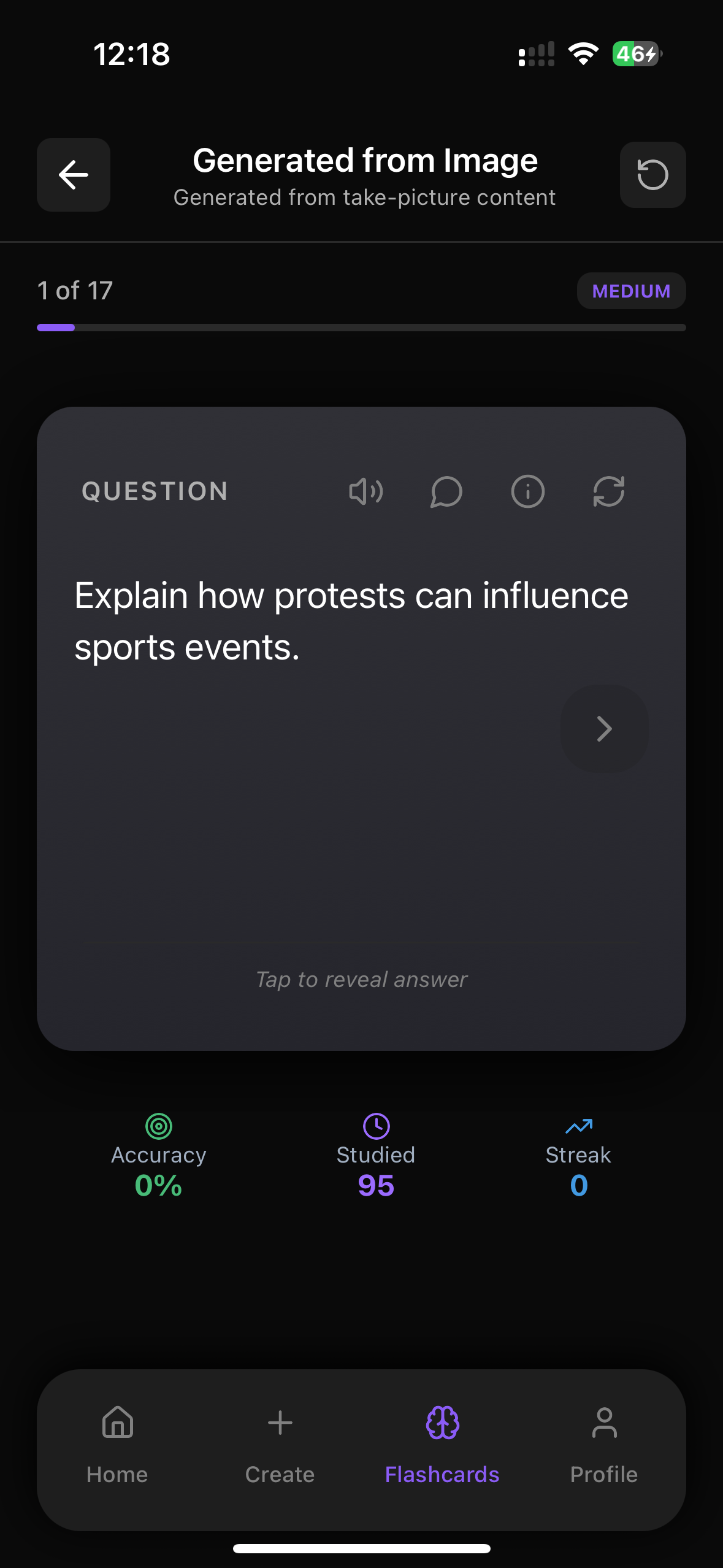
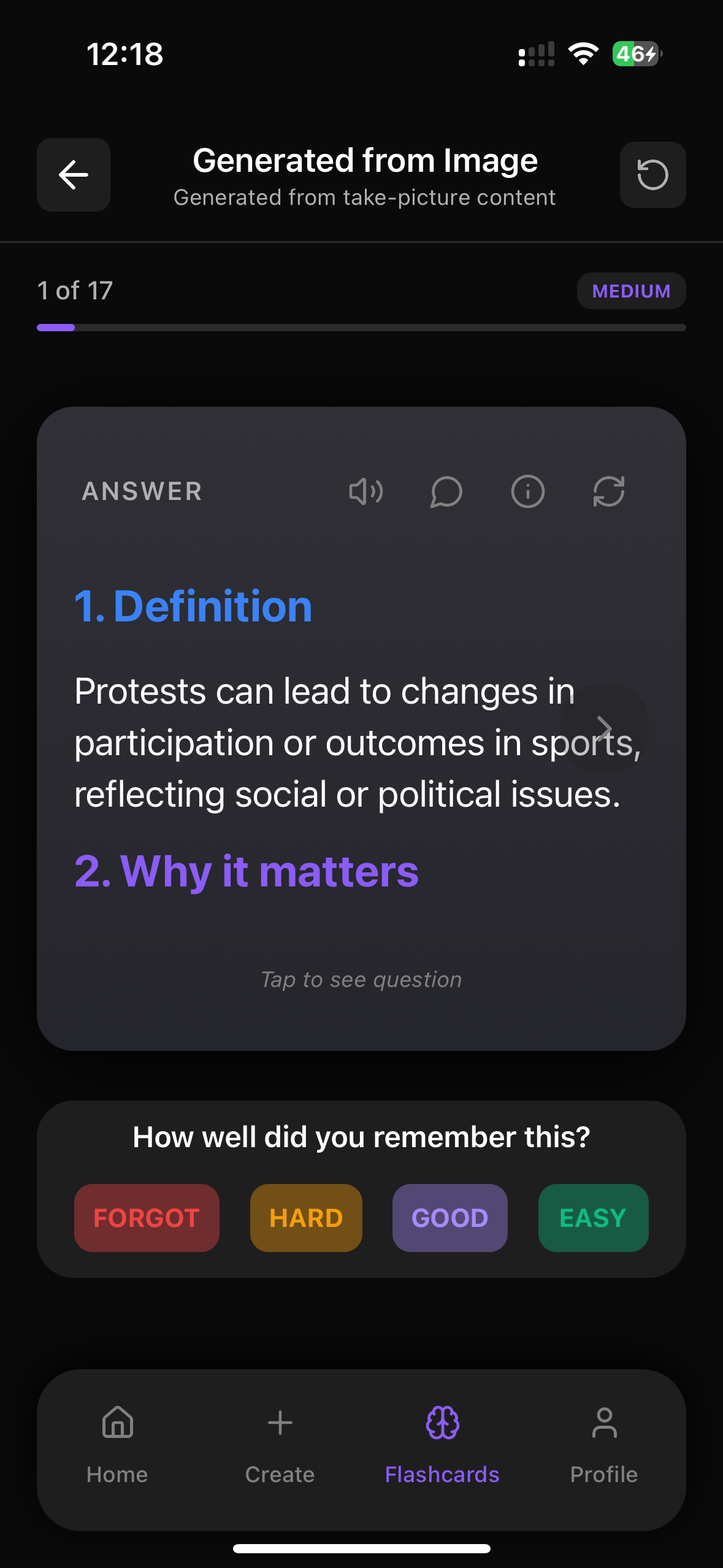
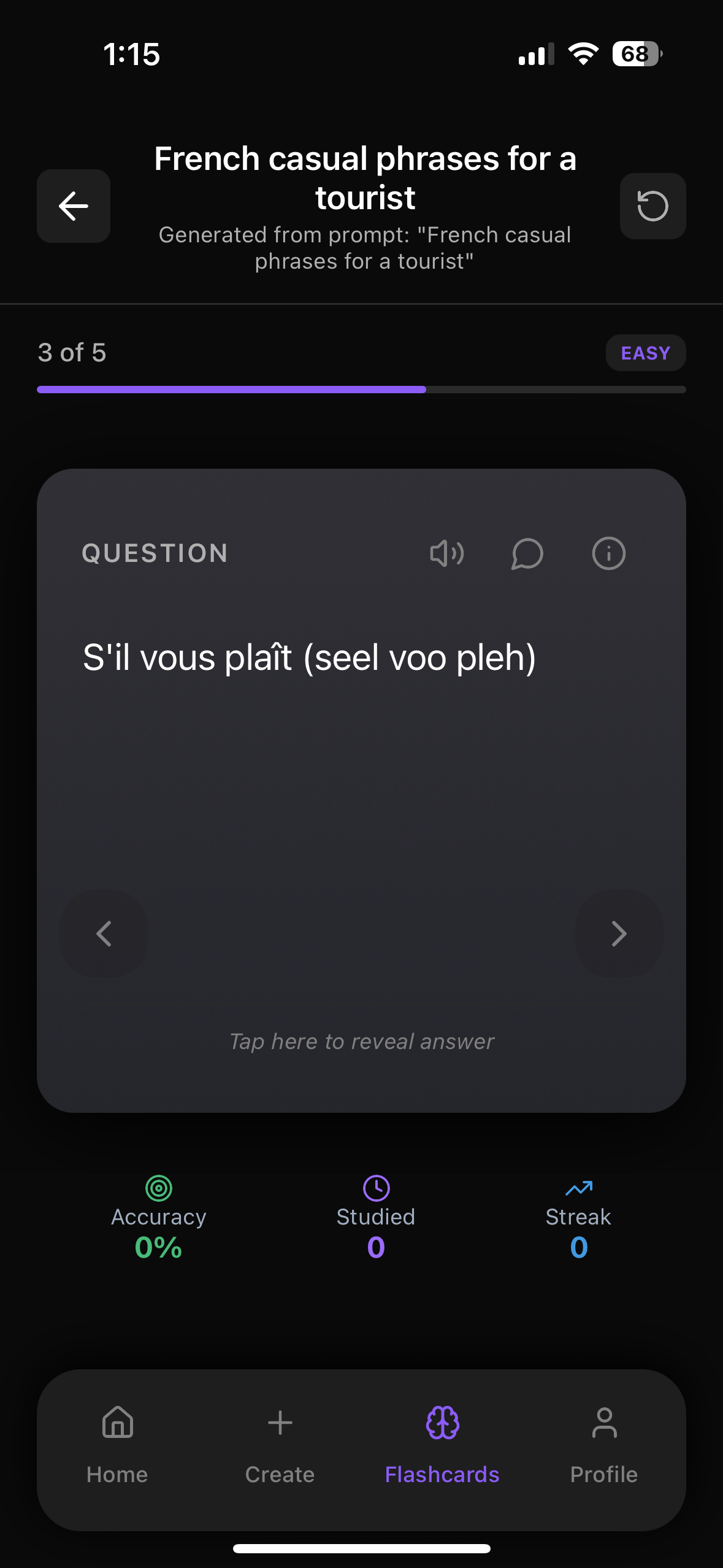
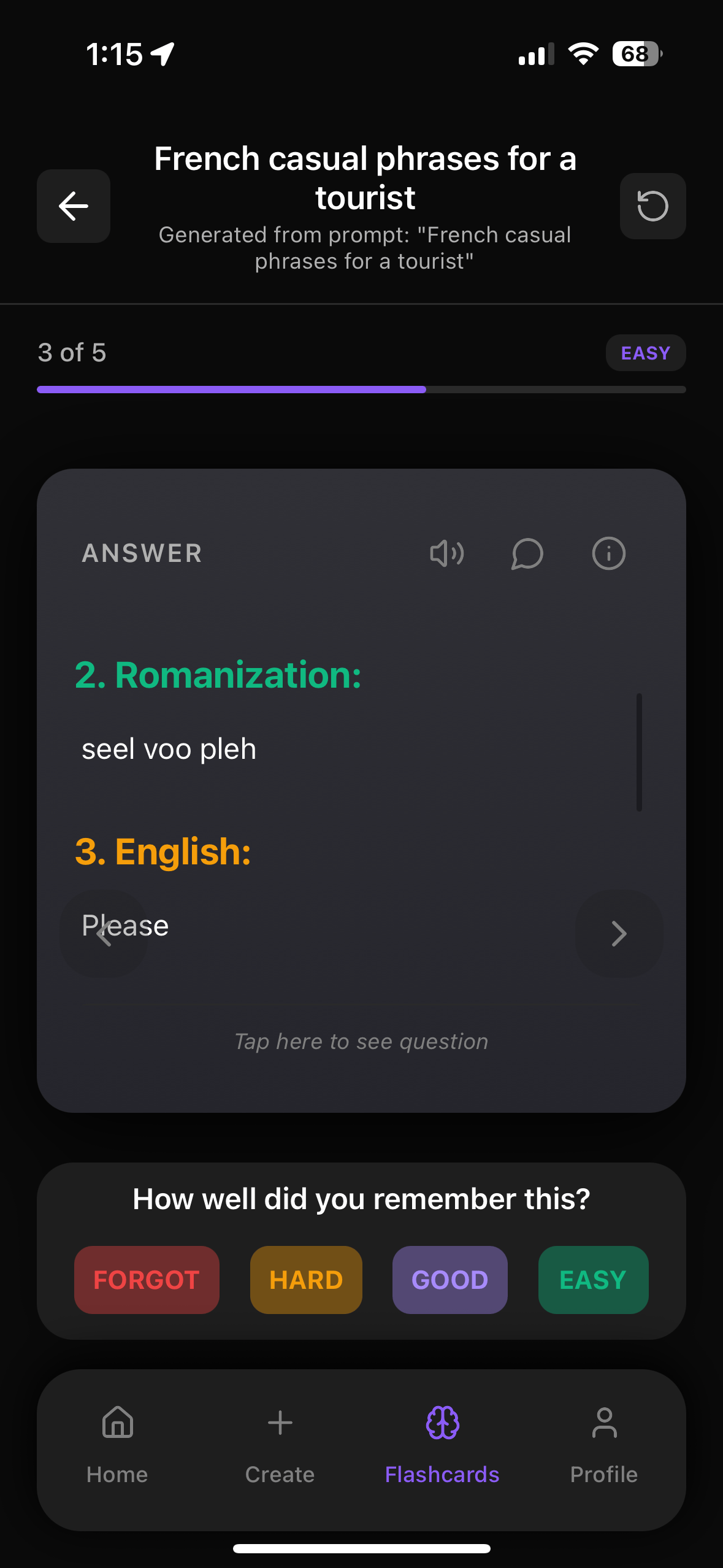
Flashrecall automatically keeps track and reminds you of the cards you don't remember well so you remember faster. Like this :
You can use Flashrecall to turn practice questions or passages into cards like this. Just paste the question text or screenshot it and generate targeted cards.
5. Formula + Concept Pair Cards
You don’t want just “memorize this formula.” You want what it means and how to use it.
- Front: “What is the formula for cardiac output, and what does it represent?”
- Back: “CO = HR × SV. It represents the volume of blood the heart pumps per minute.”
You can also do:
- Front: “If heart rate increases while stroke volume stays constant, what happens to cardiac output?”
- Back: “Cardiac output increases.”
Flashrecall is great here because you can chat with your deck if you’re confused—ask it to explain the formula again in simpler terms.
6. Passage-Based “Why” Cards
A lot of people only make fact cards and then get wrecked by passages. Instead, turn practice questions into cards that focus on why the right answer is right.
- Front: “In a passage about enzyme inhibition, why would a Lineweaver-Burk plot with unchanged Vmax but increased Km indicate competitive inhibition?”
- Back: “Because competitive inhibitors increase Km (decrease affinity) without changing Vmax, since inhibition can be overcome by increasing substrate.”
You can copy explanations from your question bank and drop them into Flashrecall, then trim them into short, clean answers.
7. “Common Trap” Cards
Any time you get a question wrong and think “ugh, I always mix this up,” that deserves a flashcard.
- Front: “What’s the key difference between availability heuristic and representativeness heuristic?”
- Back: “Availability = judging likelihood based on how easily examples come to mind. Representativeness = judging based on how much something matches a prototype or stereotype.”
These are perfect for spaced repetition because you know your brain wants to forget or confuse them.
Should You Use Pre-Made Anki Decks For MCAT?
Short answer: they can help, but don’t rely on them blindly.
Pros of big Anki decks like Milesdown/AnKing:
- Tons of content already done
- Usually cover all sections
- Good if you’re starting from zero
Cons:
- Overwhelming number of cards
- Not tailored to your weak areas
- Easy to end up reviewing cards passively just to “get through them”
A smarter approach:
1. Use pre-made decks sparingly for reference or to fill gaps
2. Make your own cards based on:
- Practice questions you miss
- Concepts you keep forgetting
- High-yield notes from your main content source
Flashrecall is perfect for this “custom but fast” approach. Instead of downloading a 30k-card monster deck, you build a lean, high-yield deck by:
- Snapping pics of tricky pages in your review book
- Converting your own notes into cards
- Turning explanations from wrong questions into flashcards
You’ll end up with fewer cards, but way more relevant to your brain.
How To Use Flashrecall As Your MCAT Flashcard Hub
Here’s a simple way to set things up:
1. Create Decks By Section
Make decks like:
- “MCAT – Bio/Biochem”
- “MCAT – Chem/Phys”
- “MCAT – Psych/Soc”
- “MCAT – CARS (strategies & vocab)”
Flashrecall lets you create all of these easily on your phone, and you can study them offline anywhere.
2. Add Cards Daily From What You Study
Studied amino acids today?
- Upload your notes or screenshot a summary chart
- Let Flashrecall auto-generate cards
- Clean up or add your own tricky ones
Did a UWorld or AAMC question block?
- Take screenshots of questions you missed
- Turn the explanations into “why” cards
3. Let Spaced Repetition Do Its Thing
Flashrecall has built-in spaced repetition + reminders, so you just:
- Open the app
- Review what’s due
- Add a few new cards from whatever you studied that day
No messing with settings, no clunky interface. Just consistent, focused reviews.
Grab it here and test it out:
👉 https://apps.apple.com/us/app/flashrecall-study-flashcards/id6746757085
Final Thoughts: The “Best” MCAT Cards Are The Ones You’ll Actually Review
The best anki cards for MCAT aren’t some secret deck hidden on Reddit—they’re clear, focused cards that you review consistently with a good spaced repetition system.
If you like tinkering on desktop and managing big decks, Anki works.
If you want something:
- Fast to set up
- Easy on iPhone/iPad
- Great for turning real study materials into flashcards
- With built-in spaced repetition, reminders, and even AI chat for extra explanations
…then Flashrecall is honestly a better fit for most people.
You’ve got enough to stress about with the MCAT. Let your flashcard app do the heavy lifting so you can focus on actually understanding the material.
Frequently Asked Questions
Is Anki good for studying?
Anki is powerful but requires manual card creation and has a steep learning curve. Flashrecall offers AI-powered card generation from your notes, images, PDFs, and videos, making it faster and easier to create effective flashcards.
What's the fastest way to create flashcards?
Manually typing cards works but takes time. Many students now use AI generators that turn notes into flashcards instantly. Flashrecall does this automatically from text, images, or PDFs.
How do I start spaced repetition?
You can manually schedule your reviews, but most people use apps that automate this. Flashrecall uses built-in spaced repetition so you review cards at the perfect time.
How can I study more effectively for this test?
Effective exam prep combines active recall, spaced repetition, and regular practice. Flashrecall helps by automatically generating flashcards from your study materials and using spaced repetition to ensure you remember everything when exam day arrives.
Related Articles
- Anatomy Flashcards Printable: 7 Powerful Study Tricks Most Med Students Don’t Use Yet – But Should
- AnkiApp Flashcards: 7 Powerful Reasons To Switch To A Faster, Smarter Study App Today – Most Students Don’t Realize How Much Easier Flashcards Can Be Until They Try This
- Best Pharmacology Flash Cards: 7 Powerful Study Hacks Most Med Students Don’t Use Yet – Learn Drugs Faster, Remember Longer, and Finally Feel Confident for Exams
Research References
The information in this article is based on peer-reviewed research and established studies in cognitive psychology and learning science.
Cepeda, N. J., Pashler, H., Vul, E., Wixted, J. T., & Rohrer, D. (2006). Distributed practice in verbal recall tasks: A review and quantitative synthesis. Psychological Bulletin, 132(3), 354-380
Meta-analysis showing spaced repetition significantly improves long-term retention compared to massed practice
Carpenter, S. K., Cepeda, N. J., Rohrer, D., Kang, S. H., & Pashler, H. (2012). Using spacing to enhance diverse forms of learning: Review of recent research and implications for instruction. Educational Psychology Review, 24(3), 369-378
Review showing spacing effects work across different types of learning materials and contexts
Kang, S. H. (2016). Spaced repetition promotes efficient and effective learning: Policy implications for instruction. Policy Insights from the Behavioral and Brain Sciences, 3(1), 12-19
Policy review advocating for spaced repetition in educational settings based on extensive research evidence
Karpicke, J. D., & Roediger, H. L. (2008). The critical importance of retrieval for learning. Science, 319(5865), 966-968
Research demonstrating that active recall (retrieval practice) is more effective than re-reading for long-term learning
Roediger, H. L., & Butler, A. C. (2011). The critical role of retrieval practice in long-term retention. Trends in Cognitive Sciences, 15(1), 20-27
Review of research showing retrieval practice (active recall) as one of the most effective learning strategies
Dunlosky, J., Rawson, K. A., Marsh, E. J., Nathan, M. J., & Willingham, D. T. (2013). Improving students' learning with effective learning techniques: Promising directions from cognitive and educational psychology. Psychological Science in the Public Interest, 14(1), 4-58
Comprehensive review ranking learning techniques, with practice testing and distributed practice rated as highly effective

FlashRecall Team
FlashRecall Development Team
The FlashRecall Team is a group of working professionals and developers who are passionate about making effective study methods more accessible to students. We believe that evidence-based learning tec...
Credentials & Qualifications
- •Software Development
- •Product Development
- •User Experience Design
Areas of Expertise
Ready to Transform Your Learning?
Start using FlashRecall today - the AI-powered flashcard app with spaced repetition and active recall.
Download on App Store