Drivers Test Flashcards Tips: The Powerful Guide
Using drivers test flashcards tips, break info into bite-sized bits to boost retention. Flashrecall helps create and schedule your flashcards effortlessly.
How Flashrecall app helps you remember faster. It's free
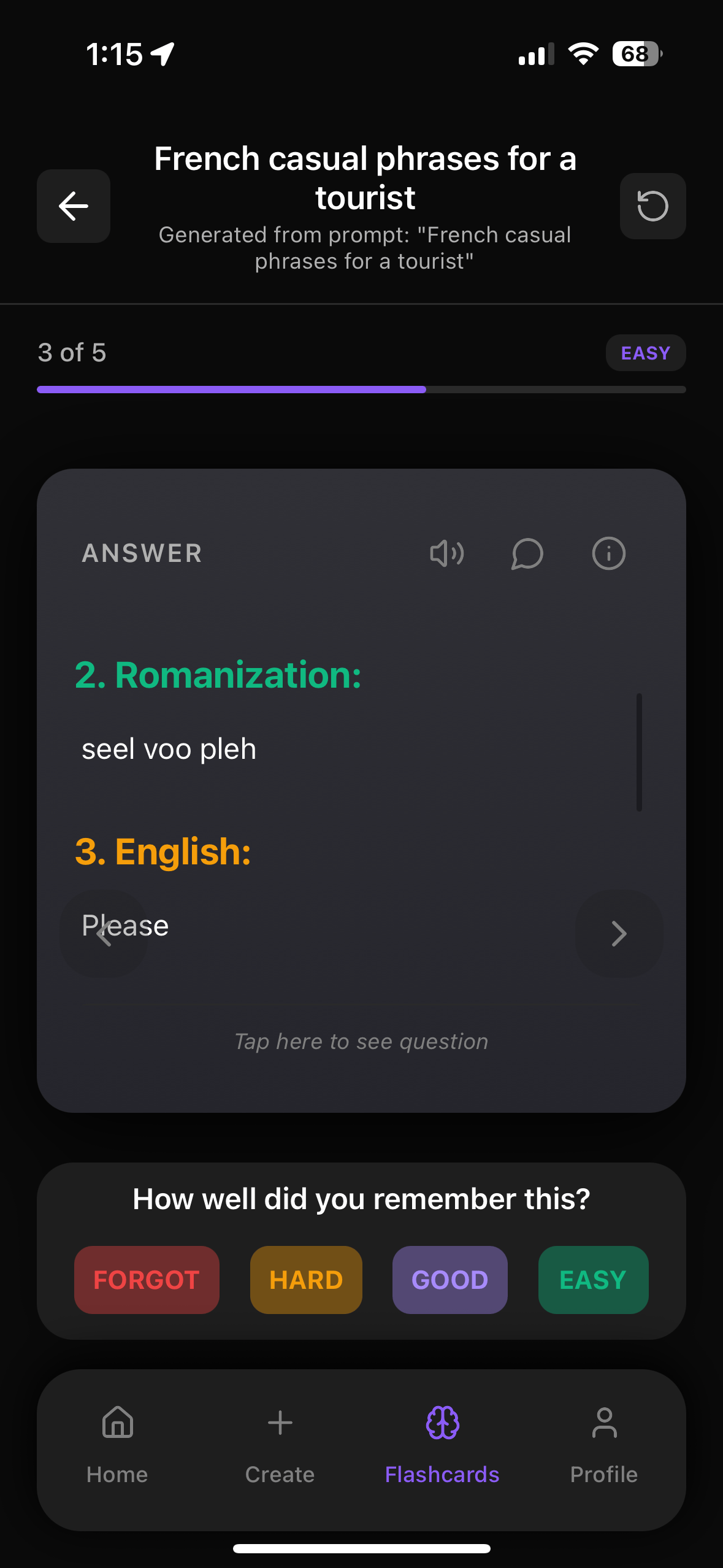
Stop Cramming, Start Passing: Why Driver’s Test Flashcards Work So Well
Alright, let's talk drivers test flashcards tips. You ever feel like there's just too much to cram into your brain all at once? I get it, it's a lot. But here's the deal: breaking info into bite-sized bits with flashcards is super handy for making that stuff stick. And honestly, using them the right way with active recall and spaced repetition is like the secret sauce. It’s all about practicing smart, not just hard.
Oh, and about Flashrecall—it’s got your back. It’s like your study buddy that takes the hassle out by whipping up flashcards from your notes and scheduling them so you don't have to stress about timing. Super chill, right? If you're gearing up for your permit test and looking for some solid drivers test flashcards tips, trust me, you’ll want to peek at our complete guide.
Instead of rereading the handbook 10 times and hoping it sticks, flashcards force your brain to actively recall the answer – which is exactly what you’ll have to do on test day.
And if you want to make driver’s test flashcards without wasting hours typing, Flashrecall makes it stupidly easy:
👉 https://apps.apple.com/us/app/flashrecall-study-flashcards/id6746757085
You can turn images, text, PDFs, even YouTube videos into flashcards in seconds, then let spaced repetition handle the review schedule for you. Way better than shuffling paper cards on your desk.
Let’s break down how to use driver’s test flashcards the smart way, and how Flashrecall can basically become your personal driving theory coach.
Why Flashcards Are Perfect For The Driver’s Test
The written test is mostly:
- Road signs
- Traffic laws
- Situational questions (who goes first, what to do at a 4‑way stop, etc.)
These are perfect for flashcards because they’re short facts and “if X then Y” rules.
Flashcards help you:
- Remember road signs quickly – see the image, recall the meaning
- Drill tricky rules – like when you can turn right on red, or following distances
- Spot weak areas – if you keep missing the same card, you know what to review
With Flashrecall, you don’t just flip cards randomly. It uses built‑in spaced repetition to show you hard cards more often and easy ones less often, so you remember everything with less study time.
Step 1: Get Your Driver’s Handbook Into Flashcards (Fast)
You don’t need to manually type the whole handbook. That’s torture.
Here’s a faster way using Flashrecall:
👉 https://apps.apple.com/us/app/flashrecall-study-flashcards/id6746757085
Option A: Turn the PDF or Text Into Cards
Most DMVs have the driver’s handbook as a PDF or web page. With Flashrecall, you can:
- Import PDFs directly and let the app generate flashcards from the content
- Copy‑paste key sections (like “Right‑of‑Way Rules” or “Parking Regulations”) and auto‑create cards
- Clean up or edit any generated cards manually if you want more control
Example:
- Copy the section about school zones
- Paste into Flashrecall
- Boom – it creates Q&A style flashcards like:
- Q: What is the typical speed limit in a school zone when children are present?
- A: Usually 15–25 mph depending on your state (check your handbook).
Option B: Use Images for Road Signs
Road signs are visual, so use image-based flashcards:
- Screenshot or download road sign charts from your DMV website
- Import the images into Flashrecall
- Turn each sign into a flashcard with:
- Front: Picture of the sign
- Back: Meaning + any extra detail (e.g., “Yield – slow down and be prepared to stop if necessary”)
You can create a whole “Road Signs” deck in like 10–15 minutes this way.
Step 2: Build Smart Driver’s Test Flashcard Decks
Instead of one giant messy deck, organize your cards into smaller, focused decks. This makes studying less overwhelming and more targeted.
Some deck ideas:
- Road Signs
- Warning signs
- Regulatory signs (stop, yield, speed limit)
- Guide signs (highway markers, exits)
- Rules of the Road
- Right‑of‑way
- Lane usage
- Passing rules
- Roundabouts
- Parking & Stopping
- Where you can’t park (fire hydrants, driveways, bus stops)
- Hill parking (uphill with curb, downhill, etc.)
- Safety & Emergencies
- What to do in a skid
- Following distances
- Headlight rules
- What to do after a minor accident
In Flashrecall, you can create as many decks as you want and study them separately or mix them when you’re ready.
Step 3: Use Active Recall the Right Way (Don’t Just “Flip” Cards)
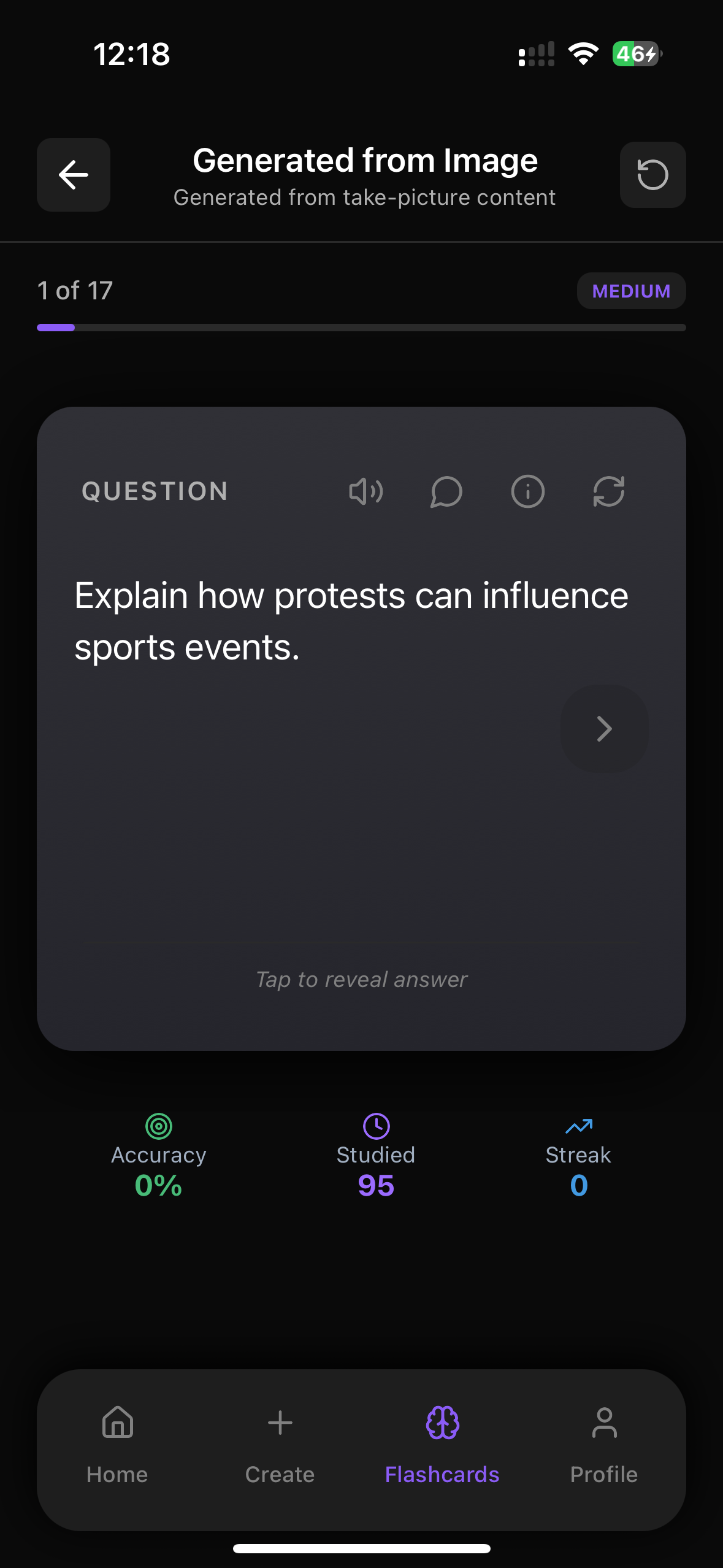
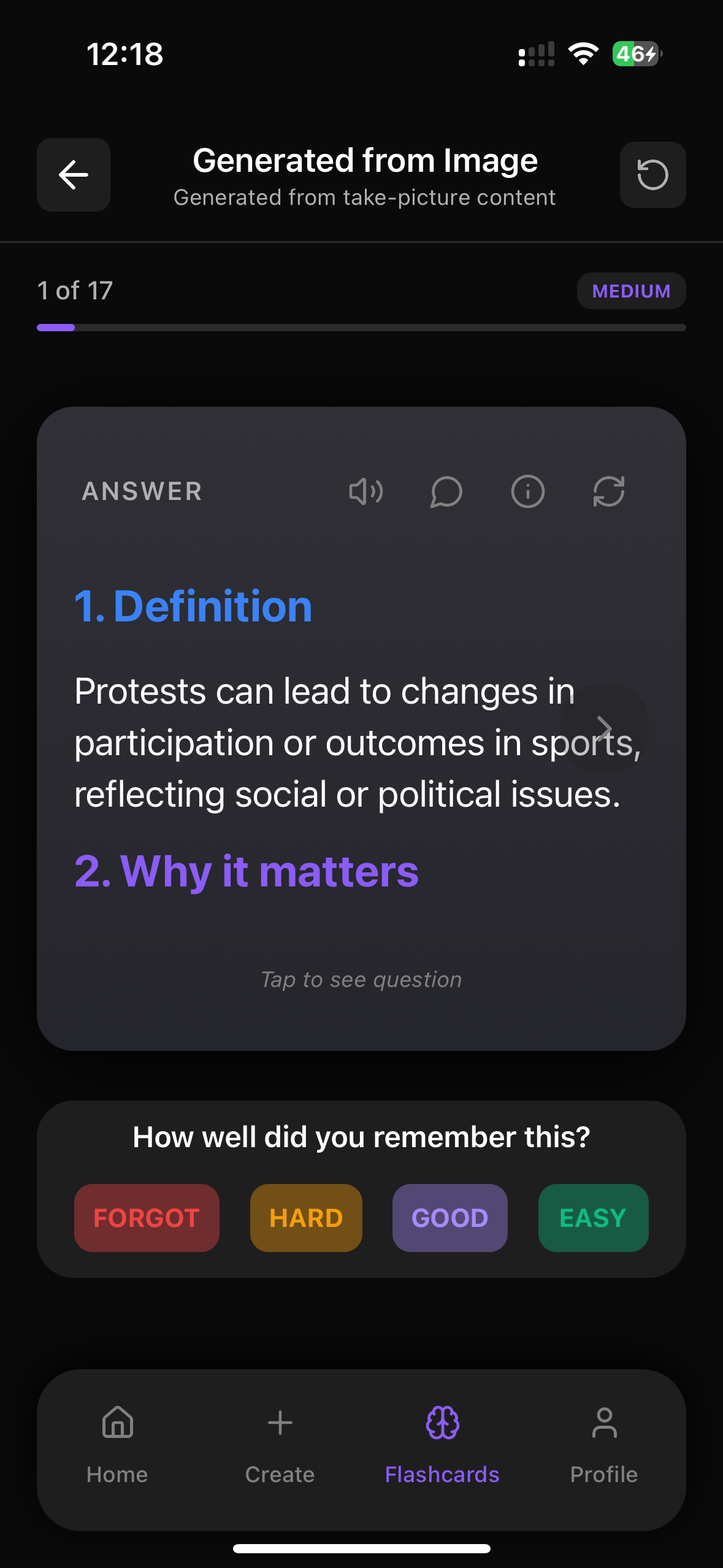
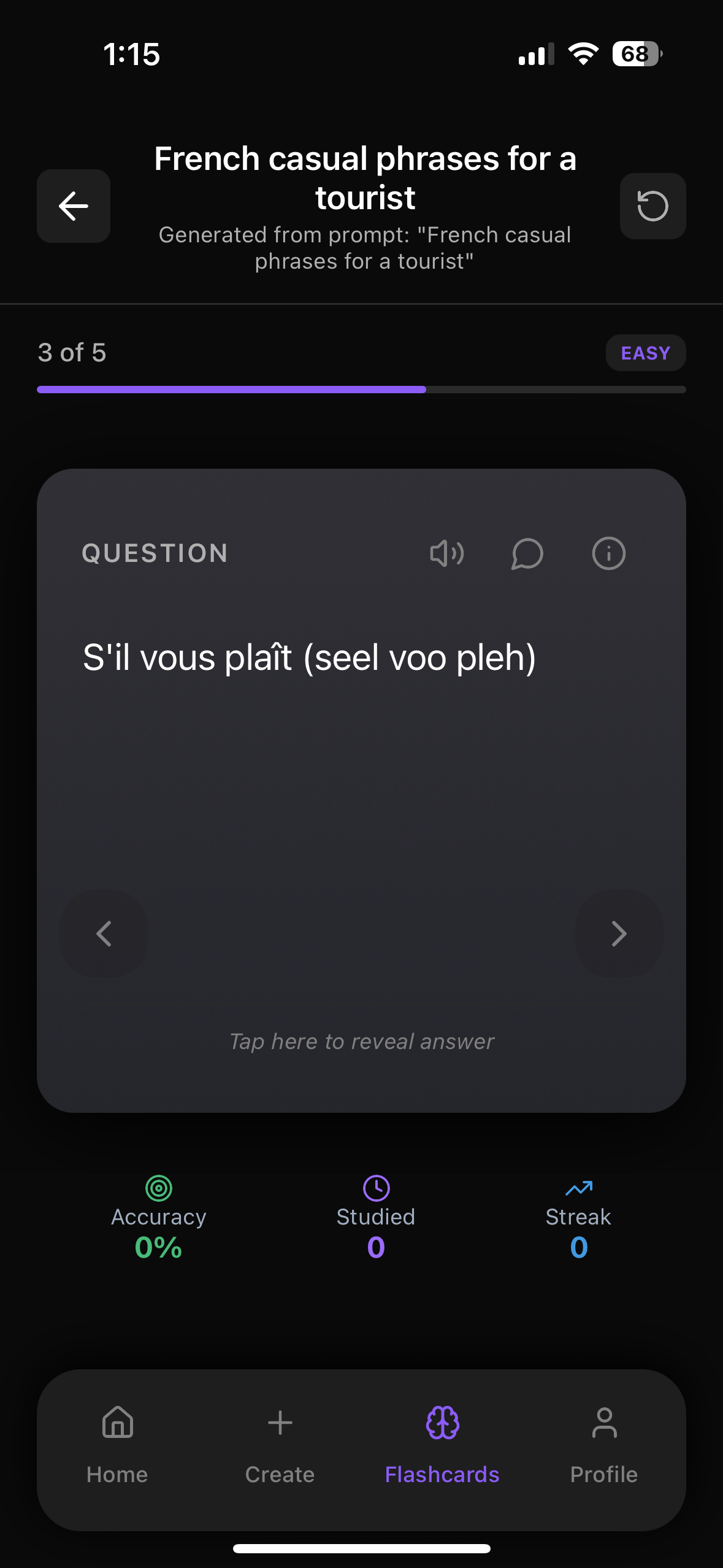
Flashrecall automatically keeps track and reminds you of the cards you don't remember well so you remember faster. Like this :
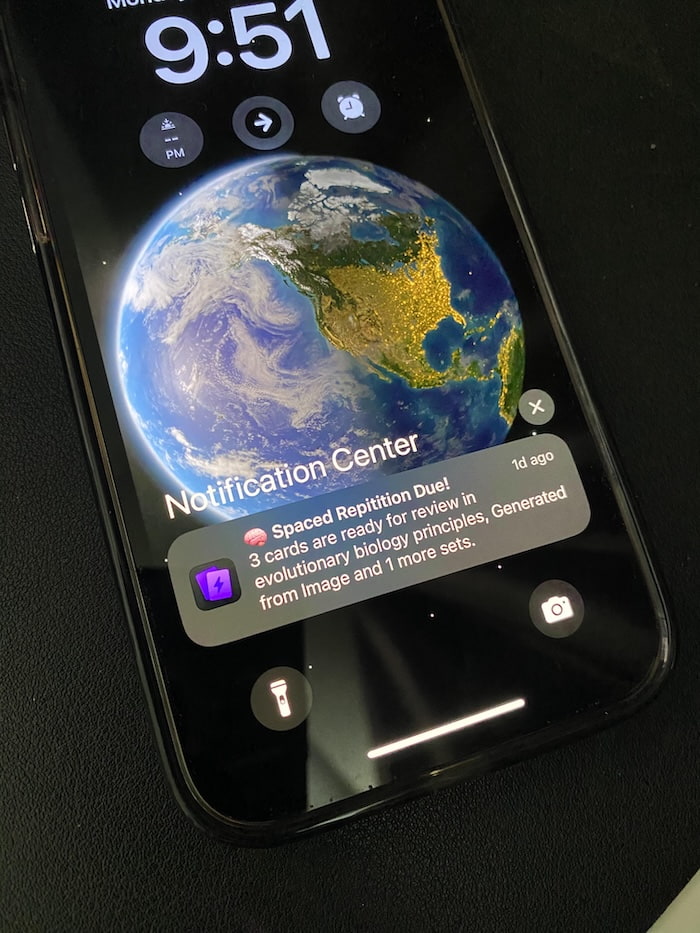
When you study flashcards, how you use them matters.
With Flashrecall, each card is built around active recall by default – you see the front, you try to answer from memory, then you reveal the back. But you have to actually play along:
1. Look at the question or sign
2. Say the answer in your head or out loud (don’t just guess mentally and flip)
3. Check if you were right
4. Rate how hard it was
Example card:
- Front: “At a 4‑way stop, who goes first?”
- Back: “The first vehicle to stop goes first. If two arrive at the same time, the vehicle on the right goes first.”
If you hesitated, mark it as “hard.” Flashrecall’s spaced repetition will then show it to you more often so you don’t forget it.
Step 4: Let Spaced Repetition Do the Heavy Lifting
Most people either:
- Cram the night before
- Or just reread the handbook and hope for the best
Spaced repetition is what helps you remember for weeks, not just for tomorrow.
Flashrecall has built-in spaced repetition with auto reminders, so you don’t have to think about when to review. The app:
- Shows you new cards a few times
- Brings them back right before you’re about to forget
- Spreads your review over days instead of one exhausting session
You’ll get gentle study reminders, so you don’t forget to actually open the app. Perfect if you’re juggling school, work, or just life.
Step 5: Turn Real Practice Tests Into Flashcards
Practice tests are gold. But instead of just doing them once and moving on, turn every missed question into a flashcard.
Here’s how:
1. Take a few online practice tests for your state
2. Screenshot or copy the questions you got wrong
3. Drop them into Flashrecall as:
- Front: The question (or scenario)
- Back: The correct answer + a short explanation
Example:
- Front: “You approach a school bus with flashing red lights on a two-lane road. What must you do?”
- Back: “Stop in both directions until the lights stop flashing and the stop sign is withdrawn, unless your state has a specific divided highway exception.”
You can even chat with the flashcard inside Flashrecall if you’re unsure and want a deeper explanation of the rule. Super handy when the handbook wording is confusing.
Step 6: Study Anywhere (Even Without Internet)
Waiting at the DMV? Riding the bus? Bored in a random line? That’s study time.
Flashrecall works offline, so you can review your driver’s test flashcards anywhere:
- On your iPhone or iPad
- Without Wi‑Fi or data
- In short 5–10 minute bursts
This is way more realistic than planning a giant 2‑hour study session you’ll probably skip.
Step 7: Example Driver’s Test Flashcards You Can Copy
Here are some sample flashcards you could create in Flashrecall:
- Front: Image of a yellow diamond with a curved arrow and a speed limit number
- Front: Image of a red and white triangle
- Front: “When are you allowed to turn right on red?”
- Front: “What’s the typical following distance in good conditions?”
- Front: “How far must you park from a fire hydrant (typical rule)?”
- Front: “Uphill with a curb: which way do you turn your wheels?”
You can type these manually, or just paste text into Flashrecall and let it help you generate cards faster.
Why Use Flashrecall Instead of Just Paper Cards or Random Apps?
There are tons of flashcard apps, but Flashrecall is built to make studying fast, flexible, and actually enjoyable:
- Create cards instantly from:
- Images (perfect for road signs)
- Text and PDFs (driver’s handbook)
- YouTube links (driving theory videos)
- Audio or typed prompts
- Built-in active recall and spaced repetition – no manual scheduling
- Auto study reminders so you don’t forget to review
- Chat with your flashcards if you’re unsure about a concept
- Works offline, on iPhone and iPad
- Great not just for your driver’s test, but also school, university, languages, medicine, business, anything
- Fast, modern, and easy to use
- Free to start, so you can try it without committing
Grab it here and turn your driver’s test prep into something you can actually manage:
👉 https://apps.apple.com/us/app/flashrecall-study-flashcards/id6746757085
A Simple Study Plan to Pass on the First Try
Here’s a realistic 7‑day plan using Flashrecall:
- Import key parts of the handbook (signs, rules, parking)
- Build your main decks
- Start with 50–80 cards
- Add practice test questions you missed
- Review 10–20 minutes a day with spaced repetition
- Focus on “hard” cards and anything you keep forgetting
- Mix all decks together for realistic practice
- Quick review of all cards
- Especially: road signs, right‑of‑way, and parking rules
By test day, you’ll have seen every important concept multiple times, right when your brain needed it.
If you want your permit test to feel like a formality instead of a gamble, set up your driver’s test flashcards now and let Flashrecall handle the hard part:
👉 https://apps.apple.com/us/app/flashrecall-study-flashcards/id6746757085
Frequently Asked Questions
What's the fastest way to create flashcards?
Manually typing cards works but takes time. Many students now use AI generators that turn notes into flashcards instantly. Flashrecall does this automatically from text, images, or PDFs.
Is there a free flashcard app?
Yes. Flashrecall is free and lets you create flashcards from images, text, prompts, audio, PDFs, and YouTube videos.
How do I start spaced repetition?
You can manually schedule your reviews, but most people use apps that automate this. Flashrecall uses built-in spaced repetition so you review cards at the perfect time.
What is active recall and how does it work?
Active recall is the process of actively retrieving information from memory rather than passively reviewing it. Flashrecall forces proper active recall by making you think before revealing answers, then uses spaced repetition to optimize your review schedule.
How can I study more effectively for exams?
Effective exam prep combines active recall, spaced repetition, and regular practice. Flashrecall helps by automatically generating flashcards from your study materials and using spaced repetition to ensure you remember everything when exam day arrives.
Related Articles
- Decoding Flashcards: The Essential Guide To Learning Faster With Powerful Memory Tricks – Discover how to turn any confusing flashcard into a simple, unforgettable memory tool most students never use.
- A+ Flashcards: Proven Tips To Study Smarter, Get Higher Grades, And Actually Remember Stuff – Most Students Never Learn These Simple Flashcard Secrets
- CMAA Quizlet: Why Most Students Get Stuck (And The Flashcard Upgrade That Helps You Pass Faster) – Stop scrolling through random sets and start studying in a way that’s actually built to help you crush your CMAA exam.
Research References
The information in this article is based on peer-reviewed research and established studies in cognitive psychology and learning science.
Cepeda, N. J., Pashler, H., Vul, E., Wixted, J. T., & Rohrer, D. (2006). Distributed practice in verbal recall tasks: A review and quantitative synthesis. Psychological Bulletin, 132(3), 354-380
Meta-analysis showing spaced repetition significantly improves long-term retention compared to massed practice
Carpenter, S. K., Cepeda, N. J., Rohrer, D., Kang, S. H., & Pashler, H. (2012). Using spacing to enhance diverse forms of learning: Review of recent research and implications for instruction. Educational Psychology Review, 24(3), 369-378
Review showing spacing effects work across different types of learning materials and contexts
Kang, S. H. (2016). Spaced repetition promotes efficient and effective learning: Policy implications for instruction. Policy Insights from the Behavioral and Brain Sciences, 3(1), 12-19
Policy review advocating for spaced repetition in educational settings based on extensive research evidence
Karpicke, J. D., & Roediger, H. L. (2008). The critical importance of retrieval for learning. Science, 319(5865), 966-968
Research demonstrating that active recall (retrieval practice) is more effective than re-reading for long-term learning
Roediger, H. L., & Butler, A. C. (2011). The critical role of retrieval practice in long-term retention. Trends in Cognitive Sciences, 15(1), 20-27
Review of research showing retrieval practice (active recall) as one of the most effective learning strategies
Dunlosky, J., Rawson, K. A., Marsh, E. J., Nathan, M. J., & Willingham, D. T. (2013). Improving students' learning with effective learning techniques: Promising directions from cognitive and educational psychology. Psychological Science in the Public Interest, 14(1), 4-58
Comprehensive review ranking learning techniques, with practice testing and distributed practice rated as highly effective

FlashRecall Team
FlashRecall Development Team
The FlashRecall Team is a group of working professionals and developers who are passionate about making effective study methods more accessible to students. We believe that evidence-based learning tec...
Credentials & Qualifications
- •Software Development
- •Product Development
- •User Experience Design
Areas of Expertise
Ready to Transform Your Learning?
Start using FlashRecall today - the AI-powered flashcard app with spaced repetition and active recall.
Download on App Store