Geometry Flashcards Tips: The Powerful Guide
Geometry flashcards tips help you break down complex theorems into bite-sized questions. Use Flashrecall for active recall and spaced repetition to boost.
How Flashrecall app helps you remember faster. It's free
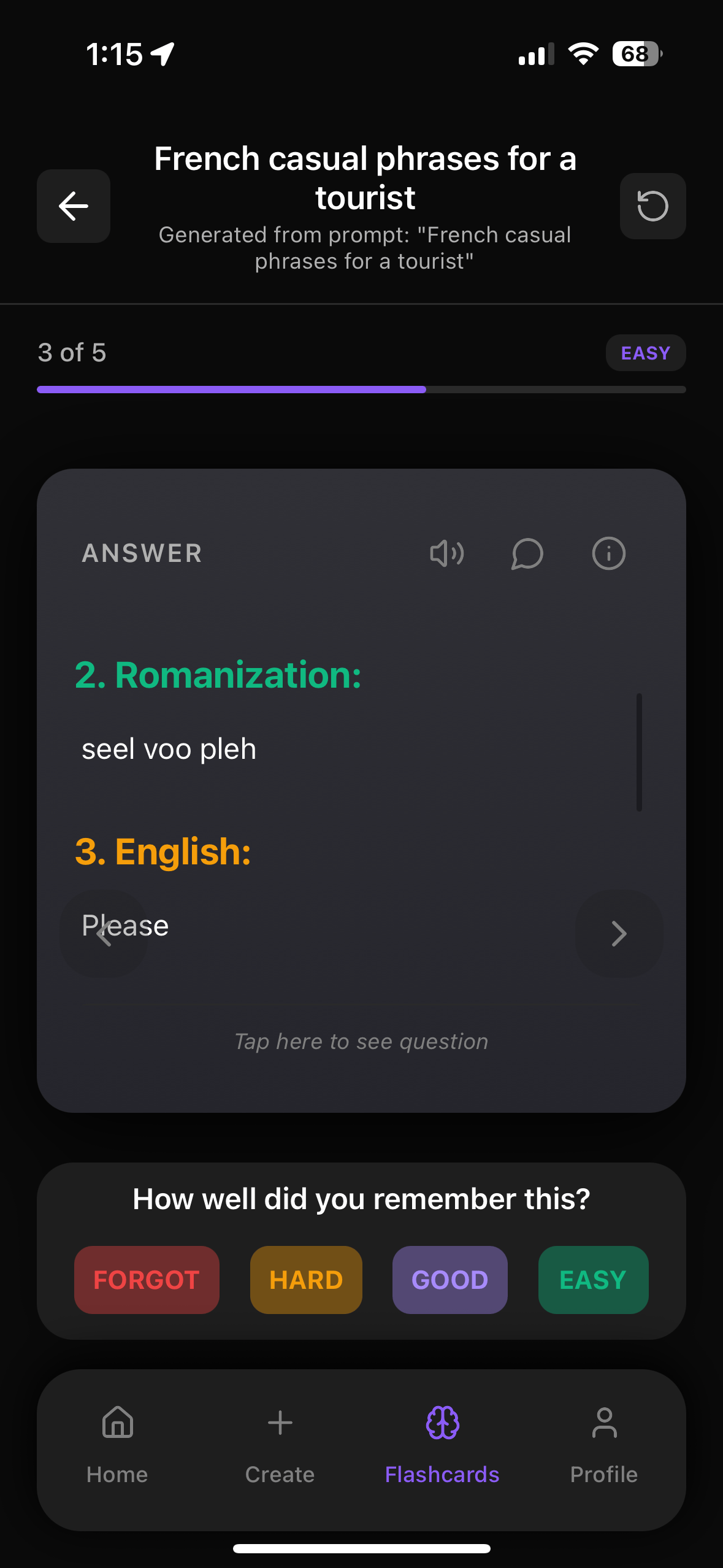
Geometry Is Hard… Unless You Turn It Into Tiny, Easy Cards
So, you ever find yourself buried under a mountain of geometry notes, trying to remember all those theorems and formulas? Geometry flashcards tips are your new best friend. Seriously, breaking down that complex info into bite-sized chunks makes things way more manageable. And here's the cool part: with active recall and spaced repetition, you'll be nailing those geometry concepts in no time. Now, Flashrecall is like your personal study buddy—it whips up flashcards from your notes and schedules those review sessions so you don't have to think about it. If you're ready to stop rereading and actually make geometry stick, check out our complete guide. Trust me, it's a game-changer!
That’s exactly what Flashrecall) is perfect for. It lets you:
- Make flashcards instantly from images, text, PDFs, YouTube links, or just typing
- Use built-in spaced repetition so the app tells you when to review
- Practice active recall instead of just re-reading notes
- Study on iPhone and iPad, even offline
- Chat with your flashcards if you’re confused about a concept
Free to start, fast, and modern. Basically, it turns geometry into bite-sized questions your brain can actually handle.
Let’s walk through how to build geometry flashcards that actually help you remember stuff for exams, not just for 5 minutes.
Why Geometry Flashcards Work So Well
Geometry is full of:
- Definitions (what is an altitude? a median? a chord?)
- Formulas (area, perimeter, volume, trig ratios)
- Diagrams (angles, triangles, circles, polygons)
- Theorems (Pythagorean theorem, triangle sum theorem, etc.)
- Proof patterns (two-column proofs, similarity, congruence)
Flashcards are perfect because they force active recall:
You see a question → your brain has to pull the answer out → memory gets stronger.
With Flashrecall, every card you review is spaced out automatically using spaced repetition, so:
- Stuff you know well appears less often
- Stuff you keep forgetting appears more often
- You don’t have to plan your review schedule at all
That’s how you stop cramming formulas the night before the test.
1. Start With Core Geometry Definitions
Before the fancy theorems, you need the basic language down.
Here are great definition-style flashcards to create:
- Front: What is a radius of a circle?
- Front: Define congruent triangles.
- Front: What is a median of a triangle?
In Flashrecall, you can:
- Copy-paste definitions from your notes or textbook
- Turn them into cards in seconds
- Or even snap a photo of your textbook page, and let Flashrecall auto-generate flashcards from the image
That saves you a ton of time vs manually typing every single definition.
2. Turn Every Formula Into a Question (Not Just a Note)
Most students just write formulas in a list and hope they’ll remember.
That doesn’t work.
You want question-based flashcards like this:
- Front: Formula for the area of a circle?
- Front: Formula for the circumference of a circle in terms of diameter?
- Front: Pythagorean Theorem?
- Front: Area of a triangle using base and height?
You can also flip them:
- Front: \( A = \frac{1}{2} b h \) — What is this the formula for?
In Flashrecall, you can group these into a “Formulas” deck and let spaced repetition hit you with the right ones at the right time so they stay fresh.
3. Use Image-Based Geometry Flashcards For Diagrams
Geometry is visual. Some things just make more sense with a picture.
With Flashrecall, you can:
- Take a photo of a diagram from your textbook or worksheet
- Highlight the part you care about
- Instantly turn it into a flashcard
Example ideas:
- Front: (Picture of a circle with radius labeled) “What is the formula for the area of this figure?”
- Front: (Triangle with sides marked 3, 4, 5) “Is this triangle right-angled? Why?”
- Front: (Diagram of two parallel lines cut by a transversal, angle marked) “Name this angle relationship.”
You can even import PDFs or screenshots of practice problems into Flashrecall and auto-generate cards from them:
> Problem on the front → solution or hint on the back.
4. Make “Concept + Example” Flashcards For Theorems
Theorems are easier to remember when you attach an example.
Instead of just:
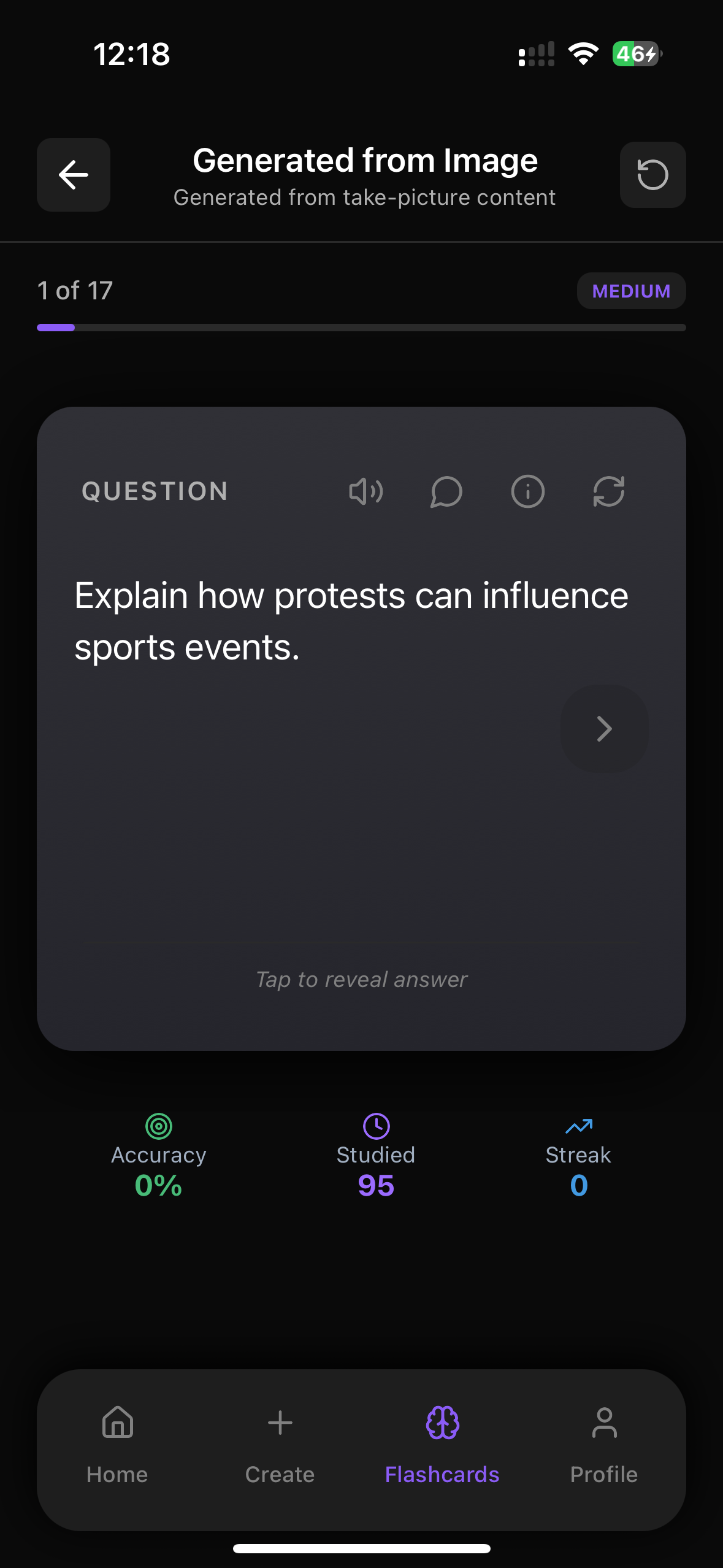
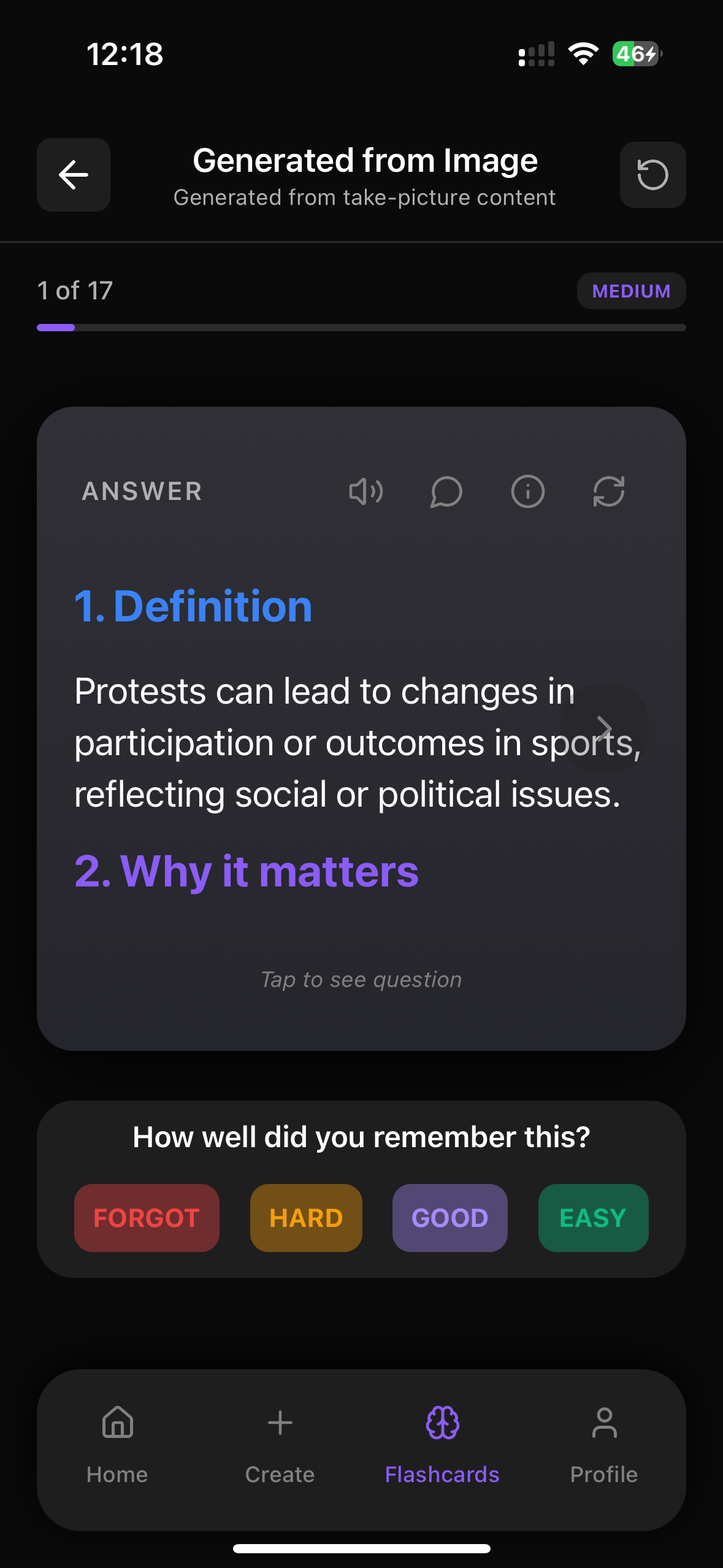
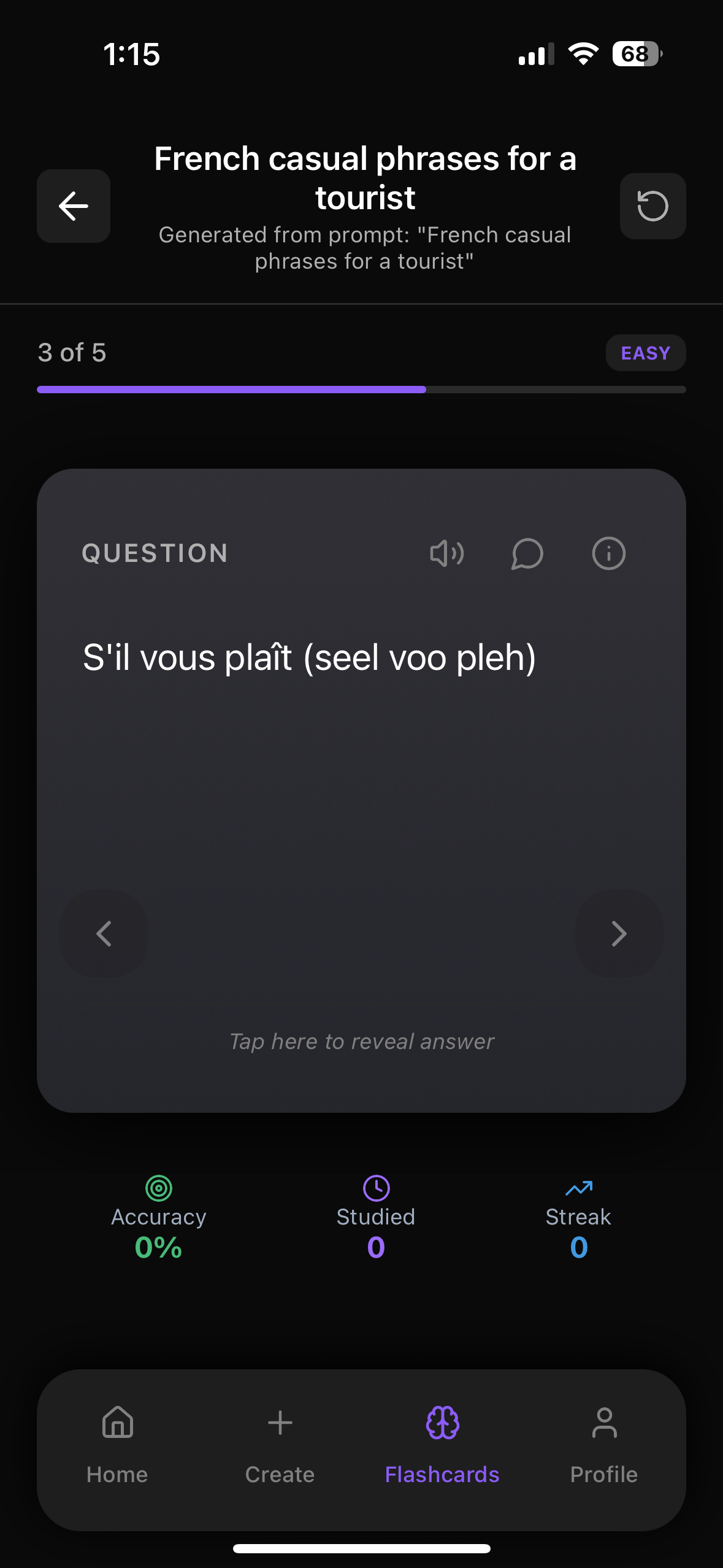
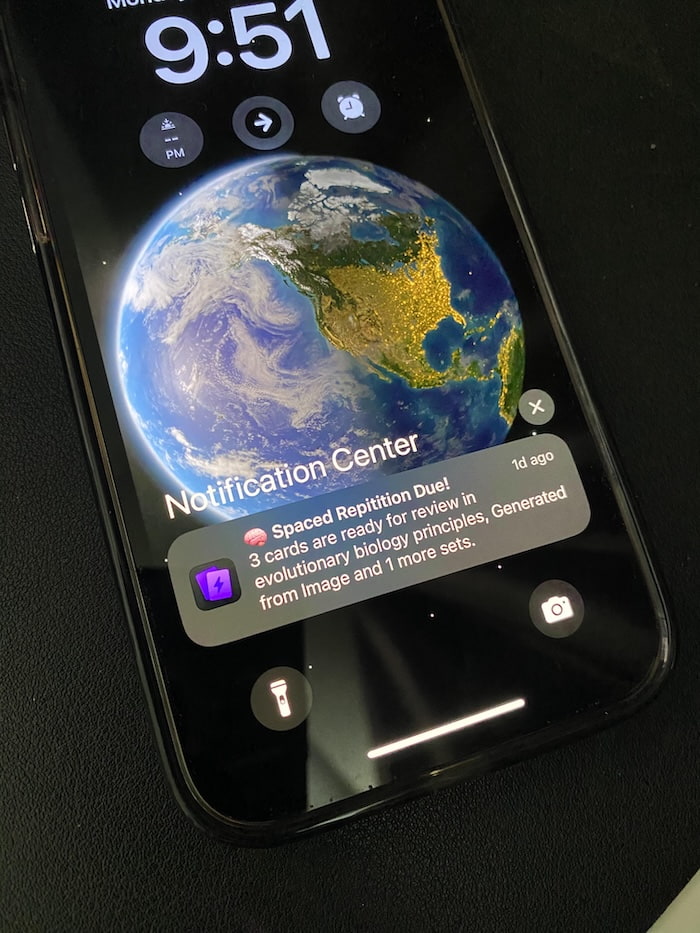
Flashrecall automatically keeps track and reminds you of the cards you don't remember well so you remember faster. Like this :
> Triangle Sum Theorem: The sum of the interior angles of a triangle is 180°.
Make it a card like this:
- Front: State the Triangle Sum Theorem and give a quick example.
Example: In a triangle with angles 50° and 60°, the third angle is 70° because \(50 + 60 + 70 = 180\).
More examples:
- Front: What does the Pythagorean Theorem say, and when can you use it?
- Front: What is the Exterior Angle Theorem?
In Flashrecall, you can also chat with the flashcard if you’re unsure:
- Ask: “Explain the Exterior Angle Theorem with another example”
- Get a clear explanation right inside the app
Super useful when you’re stuck on a concept at 11pm and don’t want to Google everything.
5. Use Word Problems As Flashcards (Not Just Formulas)
Geometry tests love word problems. Turn them into cards too.
Example:
- Front:
A circle has a radius of 7 cm. What is its area? (Use \( \pi \approx 3.14 \))
\( A = \pi r^2 = 3.14 \times 7^2 = 3.14 \times 49 \approx 153.86 \text{ cm}^2 \)
- Front:
A right triangle has legs 5 cm and 12 cm. Find the hypotenuse.
\( c^2 = 5^2 + 12^2 = 25 + 144 = 169 \Rightarrow c = 13 \text{ cm} \)
You can:
- Put the full problem on the front
- Put a step-by-step solution on the back
- Use Flashrecall’s spaced repetition so you keep seeing the tricky ones until they finally click
This is way more effective than just reading through a worksheet once.
6. Build Topic-Based Geometry Decks (So You Don’t Get Overwhelmed)
Instead of one giant “Geometry” deck with 300+ cards, break it down:
- Triangles & Congruence
- Similarity & Proportions
- Circles
- Polygons & Quadrilaterals
- Area & Perimeter
- Volume & Surface Area
- Coordinate Geometry
- Trigonometry Basics (if your course includes it)
- Proofs & Logic
In Flashrecall, you can create as many decks as you like and:
- Focus on one topic before a quiz
- Or mix decks for a “mock exam” style review
- Use study reminders so the app nudges you to review before you forget everything
Most students only review when they “feel like it.”
Study reminders + spaced repetition = you review when it actually matters.
7. How To Actually Study With Geometry Flashcards (Step-By-Step)
Here’s a simple routine you can follow using Flashrecall:
Step 1: Create or Import Cards Fast
- Snap photos of your notes / textbook diagrams
- Paste formulas or definitions from PDFs or online notes
- Type in tricky problems and solutions
- Let Flashrecall auto-generate cards from images, text, or even YouTube explanations
Step 2: Use Active Recall (No Peeking)
When a card appears:
- Answer in your head or on paper before flipping
- If you were right and confident → mark it as “Easy”
- If you were unsure or wrong → mark it as “Hard”
Flashrecall will space your reviews based on that, so you see “Hard” cards more often.
Step 3: Mix In Old And New Cards
Don’t just cram the new chapter:
- Add new cards after each class
- Keep reviewing old decks with spaced repetition
- This keeps earlier topics (like basic triangles) fresh while you move into circles, proofs, or trig.
Step 4: Use Offline Time
Waiting for the bus?
Boring 5-minute break?
Perfect for a quick geometry session.
Flashrecall works offline, so you can review anytime without Wi‑Fi.
Why Flashrecall Beats Plain Paper Flashcards For Geometry
Paper cards are fine, but they have problems:
- You have to organize and shuffle them manually
- No automatic scheduling — you decide when to review (and usually forget)
- Diagrams and screenshots are annoying to manage
- You can’t ask a paper card to explain itself
With Flashrecall:
- You get automatic spaced repetition and active recall built-in
- You can:
- Add images, diagrams, PDFs, and YouTube links
- Study on your iPhone or iPad, even offline
- Chat with your flashcards when something doesn’t make sense
- It’s fast, modern, and free to start
Grab it here:
👉 Flashrecall – Study Flashcards)
Geometry Doesn’t Have To Be A Memory Test
Most of geometry feels impossible only because you’re trying to memorize:
- 20+ formulas
- 30+ theorems
- Tons of diagrams and problem types
…all at once, usually the night before a test.
Turn it into small, smartly-timed geometry flashcards, and your brain can actually handle it.
Use Flashrecall to:
- Capture everything quickly (text, images, PDFs, YouTube)
- Let spaced repetition decide when to review
- Use active recall to lock it in
- Study anywhere, even offline
Set up a “Geometry” collection today, make a few decks, and start with just 10–20 cards.
You’ll be surprised how much easier angles, triangles, and circles feel when they show up as tiny questions instead of giant chapters.
Frequently Asked Questions
What's the fastest way to create flashcards?
Manually typing cards works but takes time. Many students now use AI generators that turn notes into flashcards instantly. Flashrecall does this automatically from text, images, or PDFs.
Is there a free flashcard app?
Yes. Flashrecall is free and lets you create flashcards from images, text, prompts, audio, PDFs, and YouTube videos.
How do I start spaced repetition?
You can manually schedule your reviews, but most people use apps that automate this. Flashrecall uses built-in spaced repetition so you review cards at the perfect time.
What is active recall and how does it work?
Active recall is the process of actively retrieving information from memory rather than passively reviewing it. Flashrecall forces proper active recall by making you think before revealing answers, then uses spaced repetition to optimize your review schedule.
Related Articles
Research References
The information in this article is based on peer-reviewed research and established studies in cognitive psychology and learning science.
Cepeda, N. J., Pashler, H., Vul, E., Wixted, J. T., & Rohrer, D. (2006). Distributed practice in verbal recall tasks: A review and quantitative synthesis. Psychological Bulletin, 132(3), 354-380
Meta-analysis showing spaced repetition significantly improves long-term retention compared to massed practice
Carpenter, S. K., Cepeda, N. J., Rohrer, D., Kang, S. H., & Pashler, H. (2012). Using spacing to enhance diverse forms of learning: Review of recent research and implications for instruction. Educational Psychology Review, 24(3), 369-378
Review showing spacing effects work across different types of learning materials and contexts
Kang, S. H. (2016). Spaced repetition promotes efficient and effective learning: Policy implications for instruction. Policy Insights from the Behavioral and Brain Sciences, 3(1), 12-19
Policy review advocating for spaced repetition in educational settings based on extensive research evidence
Karpicke, J. D., & Roediger, H. L. (2008). The critical importance of retrieval for learning. Science, 319(5865), 966-968
Research demonstrating that active recall (retrieval practice) is more effective than re-reading for long-term learning
Roediger, H. L., & Butler, A. C. (2011). The critical role of retrieval practice in long-term retention. Trends in Cognitive Sciences, 15(1), 20-27
Review of research showing retrieval practice (active recall) as one of the most effective learning strategies
Dunlosky, J., Rawson, K. A., Marsh, E. J., Nathan, M. J., & Willingham, D. T. (2013). Improving students' learning with effective learning techniques: Promising directions from cognitive and educational psychology. Psychological Science in the Public Interest, 14(1), 4-58
Comprehensive review ranking learning techniques, with practice testing and distributed practice rated as highly effective

FlashRecall Team
FlashRecall Development Team
The FlashRecall Team is a group of working professionals and developers who are passionate about making effective study methods more accessible to students. We believe that evidence-based learning tec...
Credentials & Qualifications
- •Software Development
- •Product Development
- •User Experience Design
Areas of Expertise
Ready to Transform Your Learning?
Start using FlashRecall today - the AI-powered flashcard app with spaced repetition and active recall.
Download on App Store