Mathematics Flashcards Tips: The Powerful Guide
Mathematics flashcards tips emphasize active recall and spaced repetition to truly learn math. Use Flashrecall to automate reviews and boost retention.
How Flashrecall app helps you remember faster. It's free
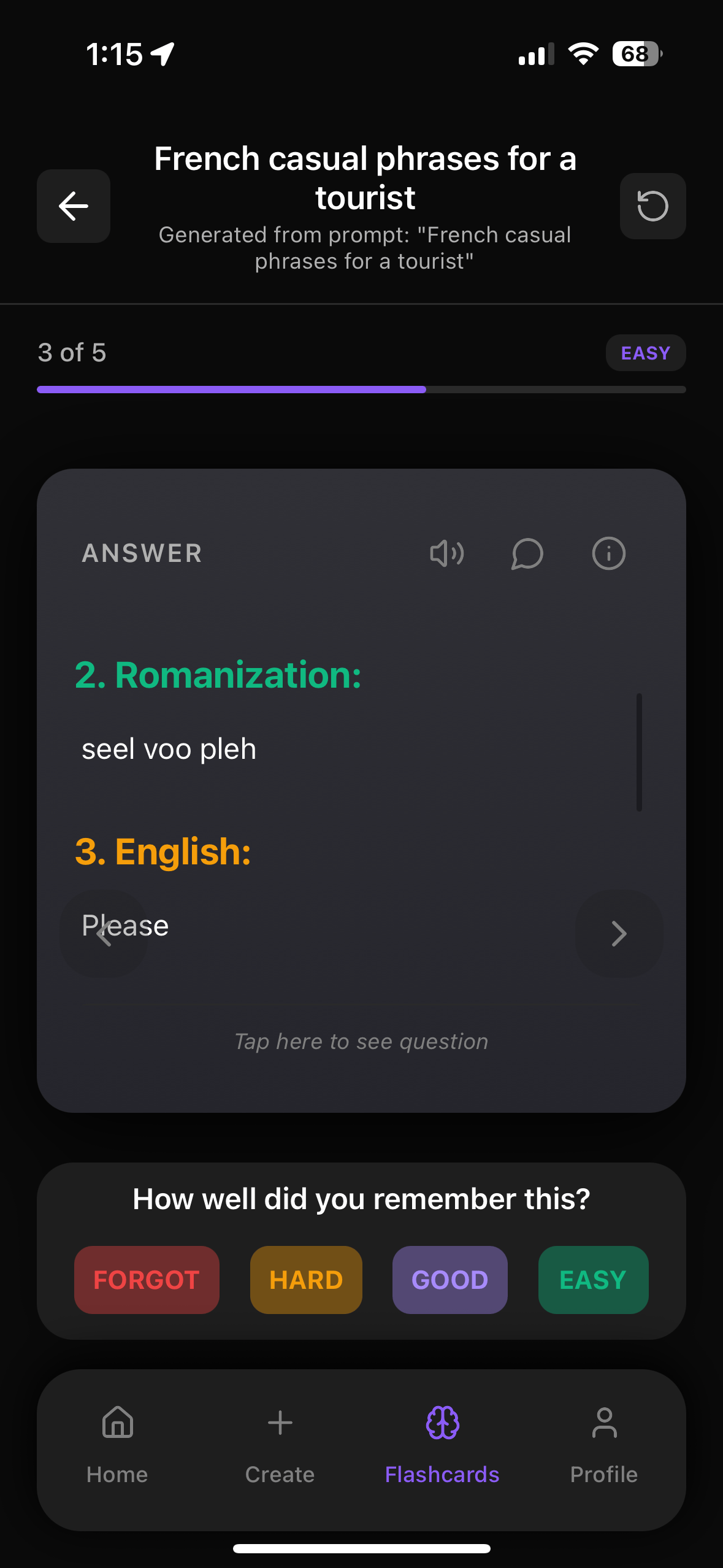
Why Math Flashcards Still Work (And Why Most People Use Them Wrong)
So, here's the scoop on mathematics flashcards tips: they're kind of a secret weapon when it comes to making math stick in your brain. Ever get tired of just reading and re-reading your notes without really getting anywhere? Yeah, we've all been there. The trick is to mix it up with active recall and spaced repetition—it's like giving your brain a workout that's actually fun. And guess what? Flashrecall can totally help with that. It takes your study materials and turns them into flashcards, scheduling your reviews so you remember stuff without cramming. Seriously, if you're looking to finally get those math formulas to stick, stop by our complete guide and see how these tips can make math a whole lot less intimidating. It's like having a math-savvy buddy in your pocket!
That’s exactly where math flashcards shine… if you use them the right way.
Instead of spending hours making cards by hand or forgetting to review them, you can let an app like Flashrecall handle the boring parts so you can focus on actually understanding math.
👉 Try Flashrecall here (free to start):
https://apps.apple.com/us/app/flashrecall-study-flashcards/id6746757085
Flashrecall lets you:
- Make math flashcards instantly from images, PDFs, notes, or just typing
- Use built-in spaced repetition and active recall (the two most effective memory techniques)
- Get automatic study reminders so you don’t forget to review
- Study offline on iPhone or iPad
Perfect for school math, exams, uni, and even advanced stuff like calculus or statistics.
Let’s break down how to actually use mathematics flashcards in a way that makes you learn faster, not just feel busy.
1. What Makes a “Good” Math Flashcard?
Most bad math flashcards look like this:
> Front: Pythagorean theorem
> Back: a² + b² = c²
That’s not a flashcard. That’s a dictionary.
A good math flashcard forces your brain to do something.
Example:
Front: Right triangle with legs 3 and 4. What is the hypotenuse?
Back: 5 (using a² + b² = c² → 3² + 4² = 9 + 16 = 25 → √25 = 5)
Front: Formula to find the hypotenuse in a right triangle?
Back: a² + b² = c² (Pythagorean theorem)
You want:
- Examples, not just formulas
- One idea per card
- Cards that make you calculate, not just read
In Flashrecall, you can quickly:
- Snap a pic of a textbook example
- Highlight the part you want
- Turn it into a flashcard in seconds
No more manually typing everything out.
2. Use Active Recall: Don’t Just “Flip Through” Cards
Active recall = trying to remember something before you see the answer.
With math, that means:
- Actually doing the calculation in your head or on paper
- Saying the steps out loud
- Then checking if you’re right
Flashrecall builds this into how you study:
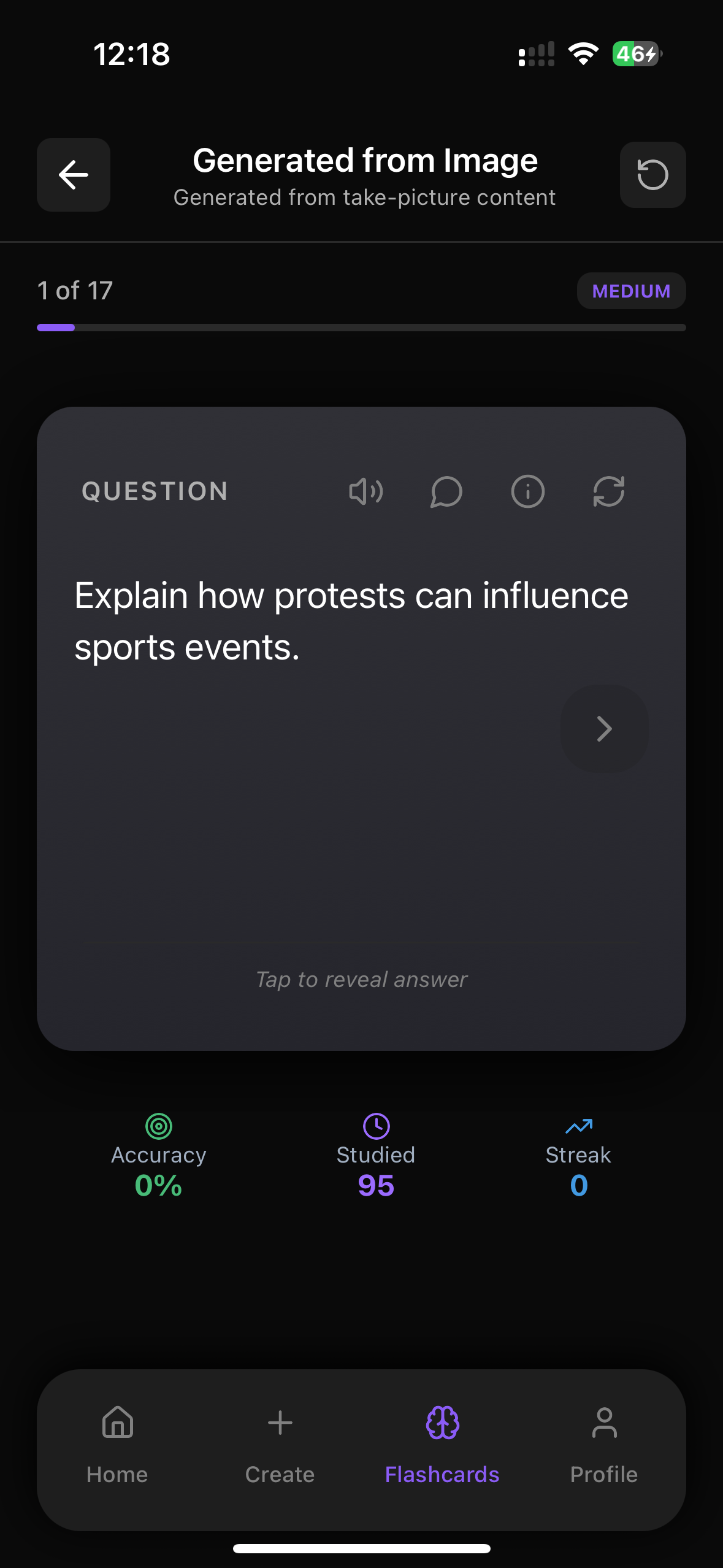
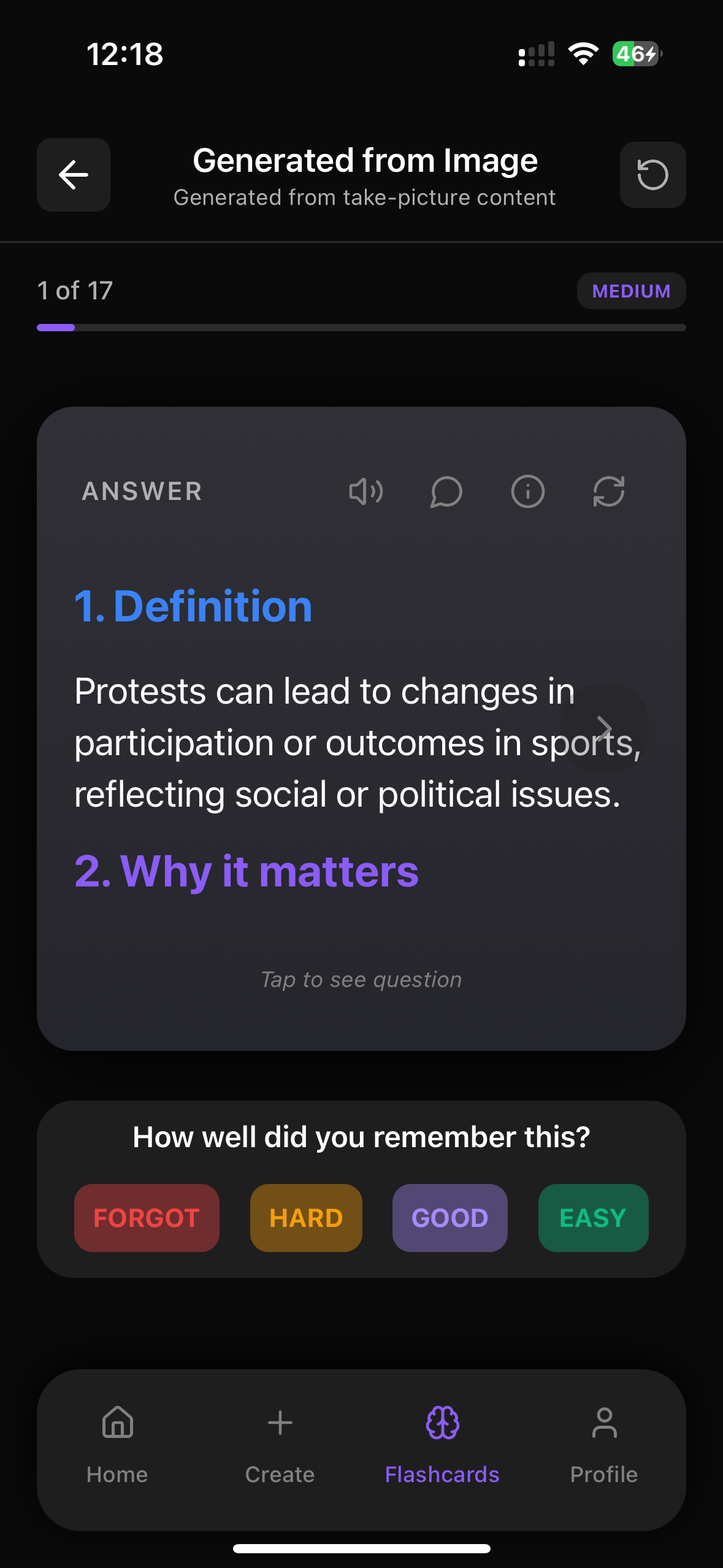
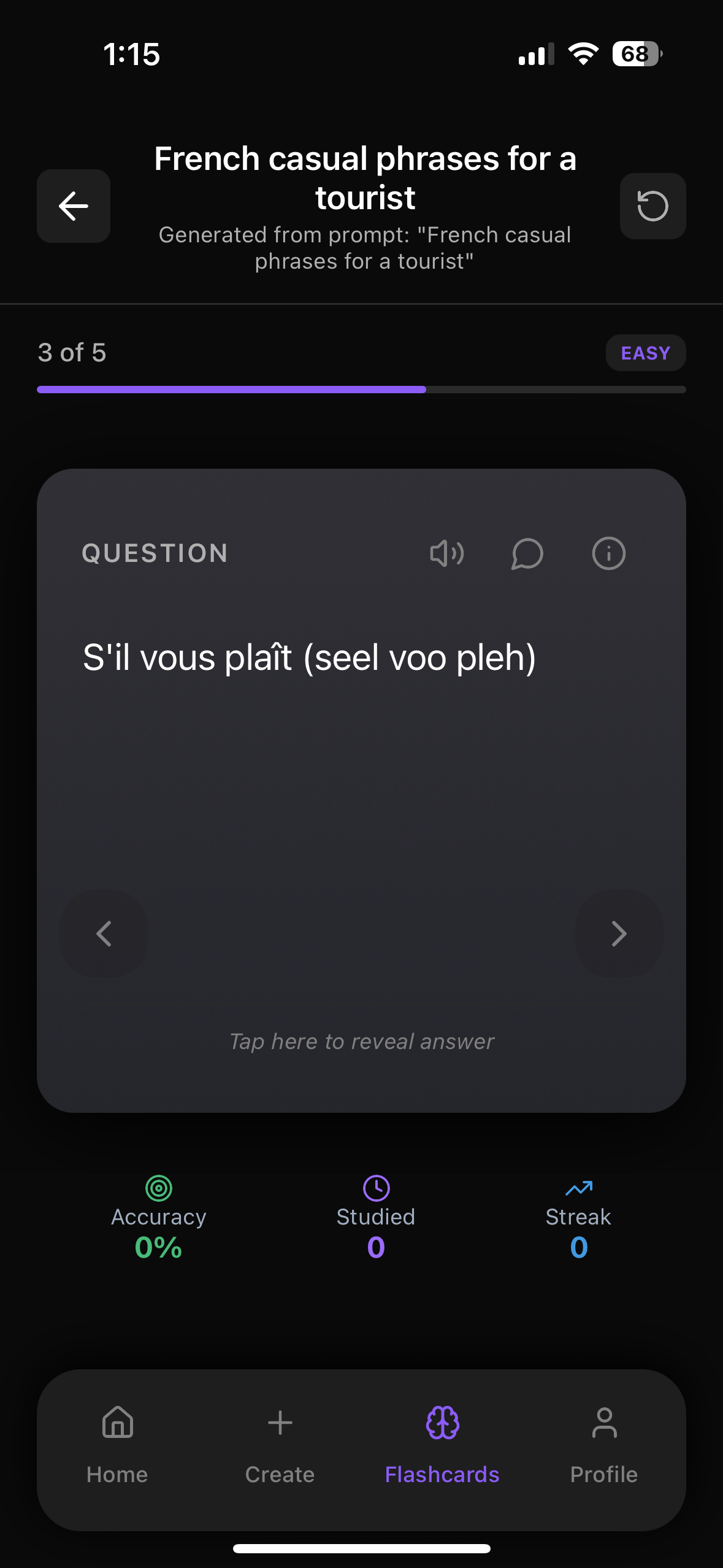
- You see the question side first
- You think / calculate
- Then you tap to reveal the answer and rate how hard it was
This is way more powerful than scrolling through notes or reading formulas.
Example: Algebra Flashcard
Front:
Solve for x: 3x – 5 = 16
Back:
x = 7
Steps:
3x – 5 = 16
3x = 21
x = 7
You:
1. Try solving it yourself
2. Flip the card
3. Compare your steps and answer
If you were unsure, Flashrecall will automatically show that card more often using spaced repetition.
3. Spaced Repetition: The Secret To Remembering Math Long-Term
Cramming the night before a math test = short-term memory.
Flashrecall automatically keeps track and reminds you of the cards you don't remember well so you remember faster. Like this :
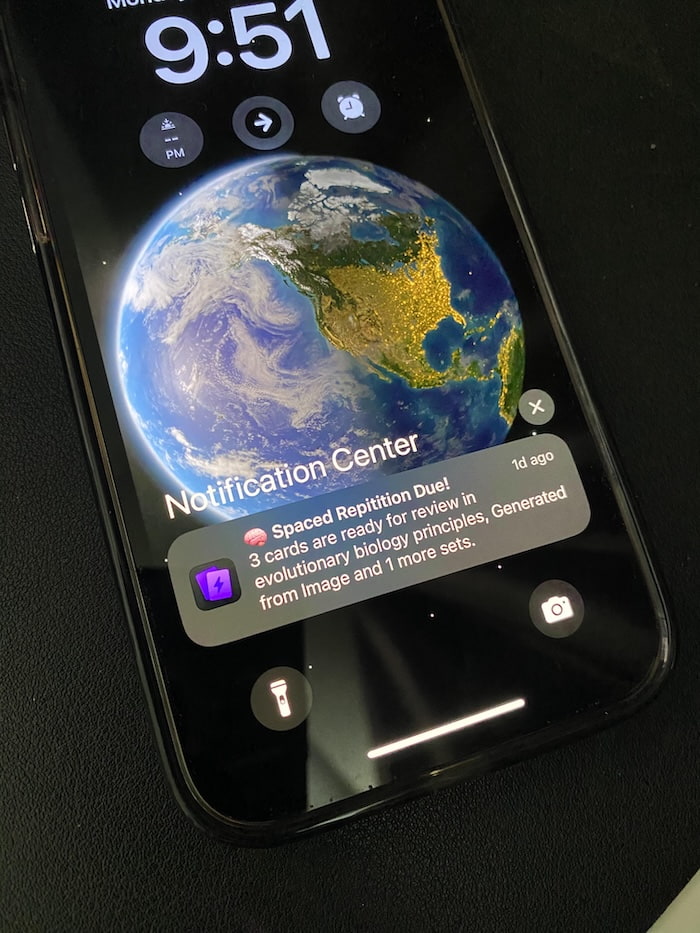
Spaced repetition = long-term memory.
Spaced repetition means:
- You review new cards often at first
- Then less and less frequently as you prove you remember them
- Hard cards come back more often, easy ones are spaced out
Flashrecall has spaced repetition built in, with:
- Automatic scheduling (you don’t have to plan anything)
- Smart review timing
- Study reminders so you actually come back to your cards
So instead of:
> “I’ll review when I remember”
You get:
> “Flashrecall reminds me exactly when I’m about to forget.”
This is huge for:
- Big exams (SAT, ACT, GCSE, A-levels, IB, university exams)
- Courses that build on each other (algebra → calculus → stats)
4. What Types of Math Flashcards Should You Make?
Here are some ideas depending on your level.
For School Math (Middle/High School)
Great card types:
- Basic operations: multiplication, division, fractions
- Formula recall: area, perimeter, volume, linear equations
- Word problems: short problems with answers & steps on the back
- Graphs & shapes: identify properties or formulas
Examples:
Front: Area of a circle with radius 4?
Back: 16π
Front: Slope formula between (2, 3) and (5, 9)?
Back: (9 – 3) / (5 – 2) = 6/3 = 2
You can create these super fast in Flashrecall:
- Type them in manually
- Or import from a PDF worksheet or notes photo and turn them into cards in seconds
For University Math (Calculus, Linear Algebra, Stats, etc.)
Here, you want more conceptual and process-based cards.
Examples:
Front: What does the derivative represent in real life?
Back: Instantaneous rate of change / slope of the tangent line
Front: Differentiate: f(x) = 3x³
Back: f’(x) = 9x²
Front: What is a matrix eigenvalue (in simple words)?
Back: A number λ such that Av = λv for some non-zero vector v
Front: What does a p-value represent?
Back: Probability of seeing results this extreme (or more) if the null hypothesis is true
You can also:
- Screenshot lecture slides
- Import them into Flashrecall
- Turn key points and examples into flashcards automatically
5. Use Images, PDFs, and YouTube For Faster Card Creation
Math is super visual, and Flashrecall leans into that.
You can create flashcards from:
- Images – snap a pic of a textbook page, whiteboard, or homework
- PDFs – upload notes or worksheets
- YouTube links – grab key ideas from math videos
- Text or typed prompts – write “make flashcards about quadratic equations” and let Flashrecall help
- Audio – record yourself explaining a concept and turn it into cards
This is especially useful for:
- Geometry diagrams
- Graphs and coordinate plane questions
- Worked examples with multiple steps
Instead of rewriting problems by hand, just capture them and turn them into cards in Flashrecall. Fast and painless.
👉 Get the app here:
https://apps.apple.com/us/app/flashrecall-study-flashcards/id6746757085
6. “Chat With Your Flashcards” When You’re Stuck
One of the coolest things in Flashrecall:
You can chat with the flashcard if you’re confused.
So if you don’t get a step in a math solution, you don’t have to just stare at it.
You can:
- Ask for a simpler explanation
- Ask for another example
- Ask “why does this step work?”
This is huge for math because:
- A lot of the time, you’re not stuck on the answer
- You’re stuck on the reasoning
Instead of Googling around or waiting to ask a teacher, you get help right inside the app, right when you need it.
7. How To Actually Study With Math Flashcards (Simple Routine)
Here’s a simple, realistic routine you can follow.
Step 1: Add Cards Right After Class
- After each class or lecture, spend 10–15 minutes:
- Snap pics of key examples
- Add important formulas
- Make cards for tricky homework problems
Do it while the material is still fresh.
Step 2: Daily 10–20 Minute Review
- Open Flashrecall
- Let it show you the cards due for review (spaced repetition handles this)
- Actually solve or explain each card before flipping
Even 10 minutes a day beats 2 hours of cramming once a week.
Step 3: Tag Decks By Topic
In Flashrecall, you can organize by:
- Algebra
- Geometry
- Trigonometry
- Calculus
- Statistics
- Exam name (SAT, GMAT, etc.)
This makes it easy to:
- Focus on weak topics before a test
- Mix decks for a full exam-style review
Step 4: Use Offline Time
Flashrecall works offline, so you can:
- Review on the bus
- Study in places with bad WiFi
- Sneak in 5–10 card sessions anywhere
Those tiny pockets of time add up fast.
Why Use Flashrecall Over Old-School Cards (Or Doing Nothing)?
Paper flashcards are fine… in theory. But:
- You have to write everything by hand
- You can’t do proper spaced repetition easily
- You can’t search, tag, or organize as well
- You definitely can’t chat with a card when you’re confused
Flashrecall gives you:
- Fast, modern, easy-to-use flashcards
- Instant creation from images, PDFs, YouTube, or text
- Built-in active recall & spaced repetition
- Automatic study reminders
- Works offline on iPhone and iPad
- Great for any subject: math, languages, medicine, business, exams, school, uni
And it’s free to start, so you can test it with your next math topic and see how much easier it feels.
👉 Download Flashrecall here and turn math into something you can actually handle:
https://apps.apple.com/us/app/flashrecall-study-flashcards/id6746757085
Final Thoughts: Math Gets Easier When You See It Enough Times
You don’t have to be “a math person.”
You just need:
- Good examples
- Smart repetition
- A system that makes sure you see the right problems at the right time
Mathematics flashcards, done properly with spaced repetition and active recall, are honestly one of the simplest ways to get better at math without doubling your study time.
Flashrecall basically automates the hard part and lets you focus on understanding.
Give it one week with your current math topic.
If you review a little every day, you’ll be surprised how much more confident you feel before your next test.
Frequently Asked Questions
What's the fastest way to create flashcards?
Manually typing cards works but takes time. Many students now use AI generators that turn notes into flashcards instantly. Flashrecall does this automatically from text, images, or PDFs.
Is there a free flashcard app?
Yes. Flashrecall is free and lets you create flashcards from images, text, prompts, audio, PDFs, and YouTube videos.
How do I start spaced repetition?
You can manually schedule your reviews, but most people use apps that automate this. Flashrecall uses built-in spaced repetition so you review cards at the perfect time.
What is active recall and how does it work?
Active recall is the process of actively retrieving information from memory rather than passively reviewing it. Flashrecall forces proper active recall by making you think before revealing answers, then uses spaced repetition to optimize your review schedule.
How can I study more effectively for exams?
Effective exam prep combines active recall, spaced repetition, and regular practice. Flashrecall helps by automatically generating flashcards from your study materials and using spaced repetition to ensure you remember everything when exam day arrives.
Related Articles
- Math Flash: The Essential Flashcard Strategy To Finally Stop Forgetting Formulas And Crush Every Test
- Math Flashcards: The Ultimate Way To Learn Faster, Beat Test Anxiety, And Actually Remember Formulas – Most Students Study Wrong, Here’s How To Fix It In Minutes
- Algebra Flashcards: 7 Powerful Ways To Finally Make Equations Click And Stick Faster – Stop re-learning the same formulas and use smart flashcards to actually remember algebra for good.
Research References
The information in this article is based on peer-reviewed research and established studies in cognitive psychology and learning science.
Cepeda, N. J., Pashler, H., Vul, E., Wixted, J. T., & Rohrer, D. (2006). Distributed practice in verbal recall tasks: A review and quantitative synthesis. Psychological Bulletin, 132(3), 354-380
Meta-analysis showing spaced repetition significantly improves long-term retention compared to massed practice
Carpenter, S. K., Cepeda, N. J., Rohrer, D., Kang, S. H., & Pashler, H. (2012). Using spacing to enhance diverse forms of learning: Review of recent research and implications for instruction. Educational Psychology Review, 24(3), 369-378
Review showing spacing effects work across different types of learning materials and contexts
Kang, S. H. (2016). Spaced repetition promotes efficient and effective learning: Policy implications for instruction. Policy Insights from the Behavioral and Brain Sciences, 3(1), 12-19
Policy review advocating for spaced repetition in educational settings based on extensive research evidence
Karpicke, J. D., & Roediger, H. L. (2008). The critical importance of retrieval for learning. Science, 319(5865), 966-968
Research demonstrating that active recall (retrieval practice) is more effective than re-reading for long-term learning
Roediger, H. L., & Butler, A. C. (2011). The critical role of retrieval practice in long-term retention. Trends in Cognitive Sciences, 15(1), 20-27
Review of research showing retrieval practice (active recall) as one of the most effective learning strategies
Dunlosky, J., Rawson, K. A., Marsh, E. J., Nathan, M. J., & Willingham, D. T. (2013). Improving students' learning with effective learning techniques: Promising directions from cognitive and educational psychology. Psychological Science in the Public Interest, 14(1), 4-58
Comprehensive review ranking learning techniques, with practice testing and distributed practice rated as highly effective

FlashRecall Team
FlashRecall Development Team
The FlashRecall Team is a group of working professionals and developers who are passionate about making effective study methods more accessible to students. We believe that evidence-based learning tec...
Credentials & Qualifications
- •Software Development
- •Product Development
- •User Experience Design
Areas of Expertise
Ready to Transform Your Learning?
Start using FlashRecall today - the AI-powered flashcard app with spaced repetition and active recall.
Download on App Store