Physiology Flashcards App: The Ultimate Guide
Flashrecall turns complex physiology concepts into simple flashcards, using active recall and spaced repetition to enhance retention and understanding.
How Flashrecall app helps you remember faster. It's free
Stop Struggling With Physiology – Flashcards Make It So Much Easier
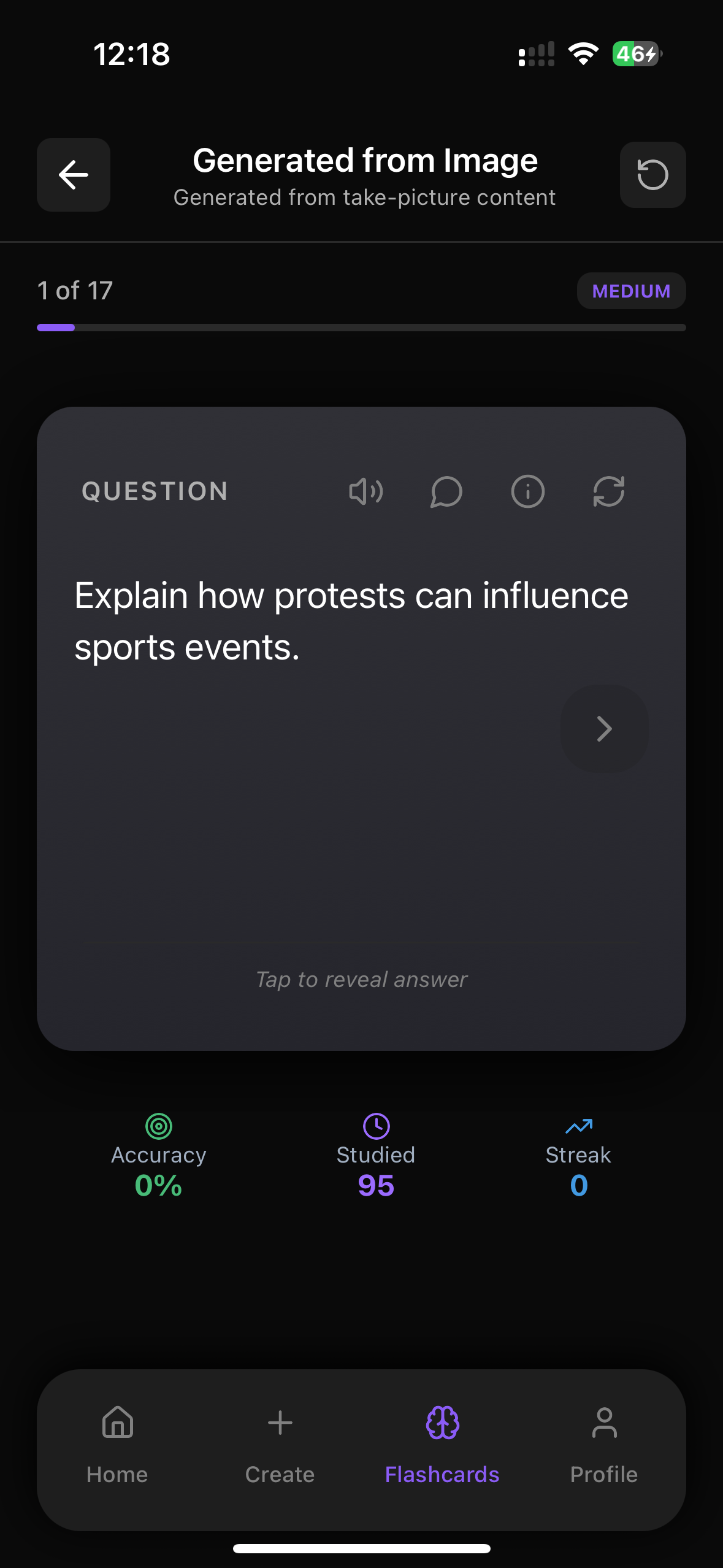
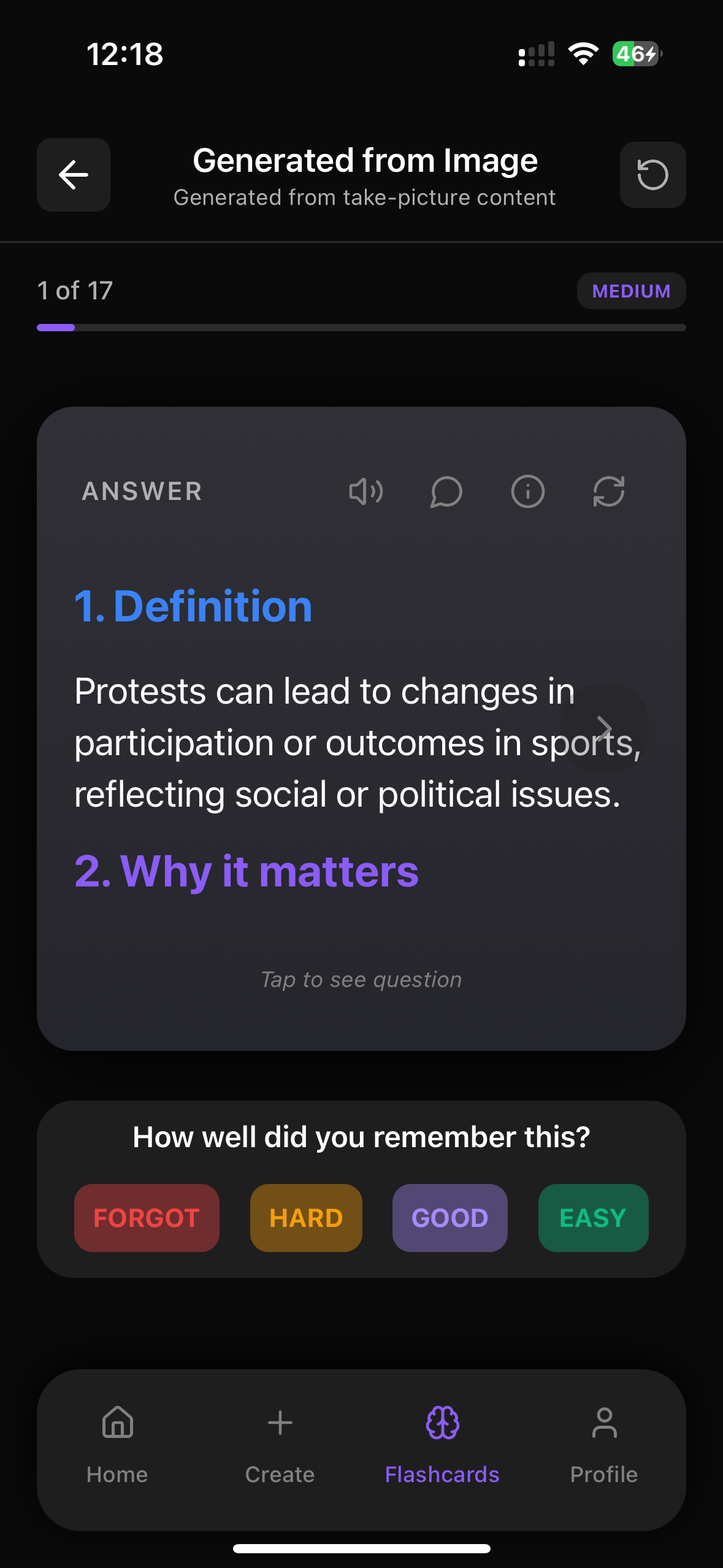
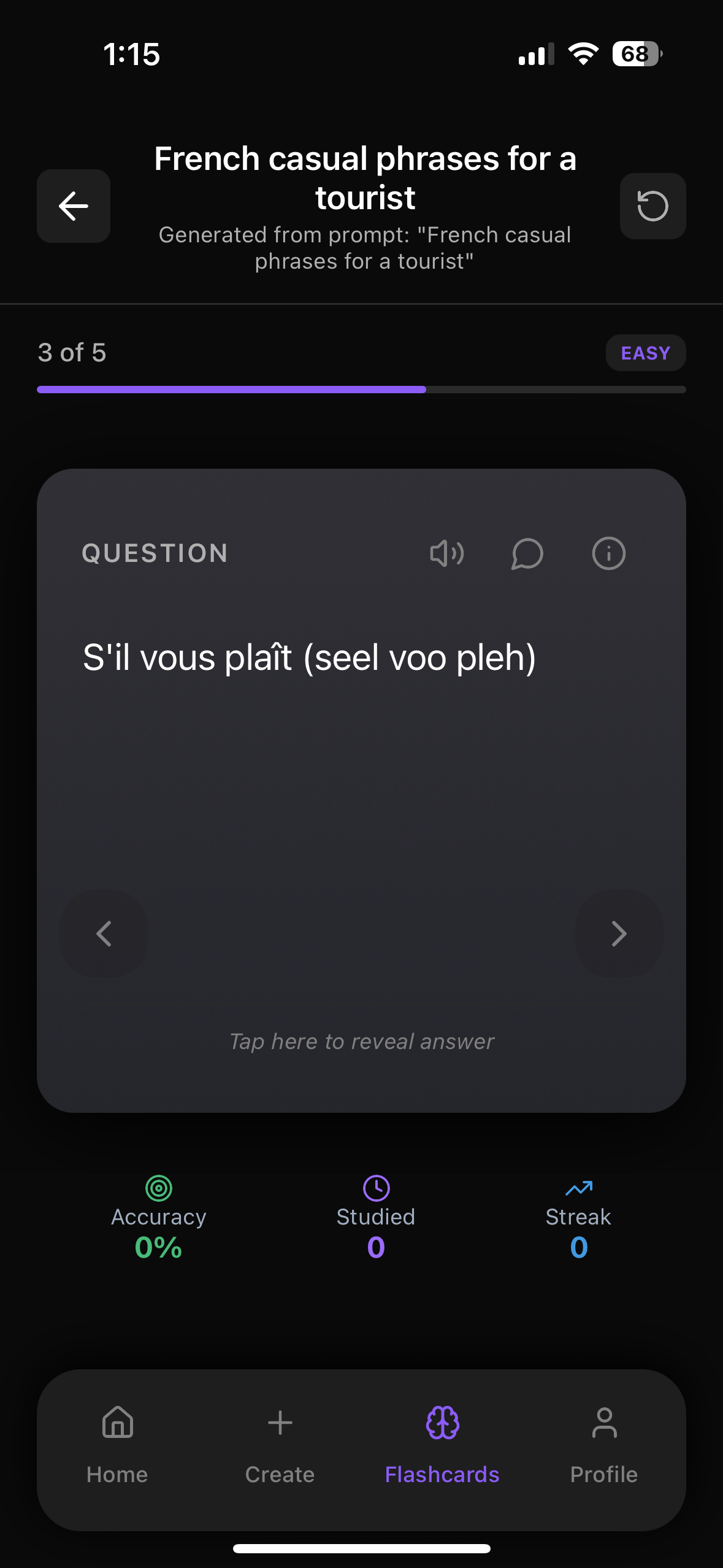
Alright, let's dive into physiology flashcards apps, shall we? Imagine slicing through all those complicated concepts and turning them into easy-peasy bits you can actually remember. Sounds like a dream, right? Well, that's where Flashrecall comes in. It takes your study stuff, whips up flashcards for you, and even tells you when it's time to review them. No more last-minute cramming or brain fog during exams. It's like having a personal study buddy who knows exactly what you need. Curious to make physiology less of a headache? Check out our complete guide and see how this app can help you outsmart those tricky topics!
Why Physiology Flashcards Work So Well
Physiology isn’t just about memorizing facts – it’s about understanding processes and then recalling them under pressure.
Flashcards are perfect for that because they force:
- Active recall – You look at a question and your brain has to retrieve the answer, not just recognize it.
- Spaced repetition – You review the hard stuff more often and the easy stuff less often, right before you’re about to forget it.
- Chunking – You break huge topics (renal, cardio, neuro) into bite-sized questions your brain can actually handle.
Flashrecall basically bakes all of this into the app for you. You just focus on learning; it handles the “when should I review this?” part with built‑in spaced repetition and automatic reminders.
What Makes a Good Physiology Flashcard?
Most people mess this up. They copy entire lecture slides onto one card and then wonder why nothing sticks.
Here’s what works better:
1. One Clear Idea Per Card
Bad card:
> “Explain the physiology of insulin, its secretion, action, regulation, and clinical relevance.”
Way too much.
Better card:
- Front: “Which cells secrete insulin and in response to what main stimulus?”
- Back: “β cells of the pancreatic islets; secreted mainly in response to increased blood glucose.”
You can then make separate cards for:
- Mechanism of action of insulin
- Effects on liver, muscle, adipose tissue
- Regulation (GLUT2, ATP-sensitive K+ channels, etc.)
- Clinical: what happens in insulin deficiency
2. Use Questions, Not Just Facts
Instead of:
> “Stroke volume = end-diastolic volume – end-systolic volume”
Use:
> Front: “How do you calculate stroke volume?”
> Back: “Stroke volume = end-diastolic volume – end-systolic volume (SV = EDV – ESV).”
This forces your brain to actually retrieve the formula.
3. Add Connections, Not Just Isolated Info
Physiology is all about relationships.
Example card:
- Front: “What happens to heart rate and blood pressure when baroreceptors sense decreased stretch?”
- Back: “↓ Stretch → ↓ Baroreceptor firing → ↑ Sympathetic, ↓ Parasympathetic → ↑ HR, ↑ contractility, vasoconstriction → ↑ BP.”
You’re not just memorizing “baroreceptors exist” – you’re memorizing the whole response.
With Flashrecall, you can create these manually, or just paste your notes and let it help you turn them into structured Q&A cards.
How To Use Flashrecall Specifically for Physiology
Here’s how I’d set up physiology in Flashrecall) if I were you.
1. Create Decks by System
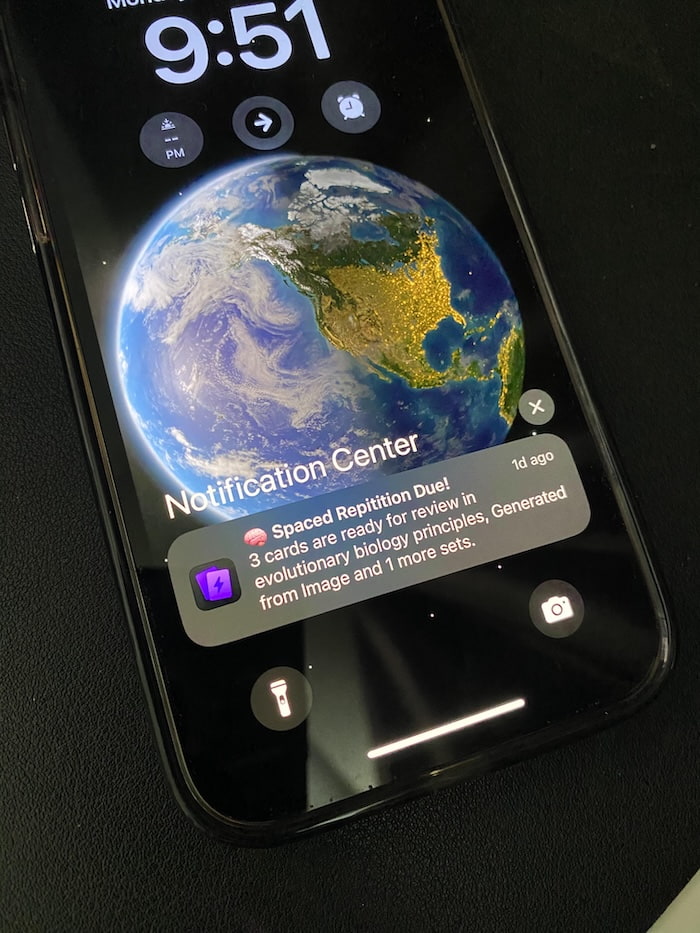
Flashrecall automatically keeps track and reminds you of the cards you don't remember well so you remember faster. Like this :
Keep things organized by body system so you’re not overwhelmed:
- Cardiovascular Physiology
- Respiratory Physiology
- Renal Physiology
- Endocrine Physiology
- Neurophysiology
- GI Physiology
- Reproductive Physiology
- Cellular & General Physiology
That way, when you’re preparing for a specific exam block, you can hammer just that system.
2. Turn Your Existing Stuff Into Cards (In Seconds)
One of the nicest things about Flashrecall is you don’t have to type every card from scratch.
You can instantly make flashcards from:
- Lecture slides & PDFs – Snap a photo or upload, and generate cards from the content.
- Text notes – Paste your physiology notes and turn key points into Q&A.
- YouTube lectures – Drop in a link and pull out the important concepts.
- Audio – Record explanations and turn them into cards.
- Or just type them manually if you like full control.
Example:
You’ve got a PDF on the renin–angiotensin–aldosterone system (RAAS).
Upload it into Flashrecall → generate flashcards like:
- “What triggers renin release from the kidney?”
- “What are the main actions of angiotensin II?”
- “How does aldosterone affect sodium and potassium levels?”
Boom. You just turned a dense PDF into something you can actually study.
Built-In Active Recall & Spaced Repetition (So You Don’t Have To Think About It)
The big advantage over paper cards or random notes: Flashrecall schedules your reviews for you.
- It uses spaced repetition to show you cards right before you’re likely to forget them.
- It has study reminders, so you don’t have to rely on motivation or memory.
- You can study offline, so you can review physiology on the bus, in the library basement, wherever.
You just open the app and it says:
“Here are the cards you need to see today to keep physiology fresh.”
That’s how you move info from “I kinda remember this” to “I can recall this instantly in an exam.”
Example Physiology Flashcards You Should Definitely Make
Here are some concrete card ideas you can copy into Flashrecall.
Cardiovascular Physiology
- Front: “What is preload?”
- Front: “How does an increase in afterload affect stroke volume?”
- Front: “What happens to cardiac output and TPR during exercise?”
Respiratory Physiology
- Front: “What is tidal volume?”
- Front: “How does CO₂ affect blood pH?”
Renal Physiology
- Front: “Where is most sodium reabsorbed in the nephron?”
- Front: “Effect of aldosterone on Na⁺ and K⁺?”
You can either:
- Type these directly, or
- Paste a chunk of notes into Flashrecall and let it help you structure them as Q&A.
Use Images and Diagrams (Super Powerful for Phys)
Physiology is full of graphs and diagrams that are way easier to memorize visually.
With Flashrecall, you can:
- Take a photo of a textbook diagram (e.g., cardiac cycle pressure-volume loop).
- Turn it into a card where:
- Front: the image with a question like “Label A, B, C.”
- Back: the labeled diagram or explanation.
Or:
- Screenshot a Starling curve, drop it into the app, and add:
- “What does a shift up and to the left on this curve represent?”
- “How does increased contractility affect this curve?”
Visual + question = way better memory.
Chat With Your Flashcards When You’re Confused
This is a cool bonus: if you’re not sure about something on a card, Flashrecall lets you chat with the flashcard to get more explanation.
So if you have a card like:
> “What is the Bohr effect?”
And you’re thinking “Okay but… why does that matter in real life?”, you can use the chat feature to ask follow-up questions and get it explained in simpler terms.
It’s like having a tiny tutor inside your flashcard deck.
How Often Should You Study Physiology Flashcards?
A simple, realistic plan:
- Every day: 15–30 minutes of Flashrecall reviews
- After each lecture: Spend 10–20 minutes turning your notes into cards
- Before exams: Add in 1–2 extra sessions focused on the relevant system (e.g., just cardio or just renal)
Because Flashrecall handles spaced repetition automatically, you’re not guessing what to review. You just open the app and trust the process.
Why Use Flashrecall Instead of Just Anki or Paper Cards?
You can use paper or other apps, but Flashrecall is built to make this whole thing way less painful:
- Fast card creation from images, PDFs, YouTube, text, audio, or manual input
- Built-in active recall & spaced repetition – no confusing settings
- Study reminders so you don’t fall behind
- Works offline – perfect for commuting or dead Wi‑Fi zones
- Chat with your flashcards when you’re stuck or want deeper understanding
- Great for anything – physiology, pathology, pharmacology, languages, business, whatever
- Free to start on iPhone and iPad
- Modern, clean, and actually nice to use (not clunky or ugly)
If you’re already drowning in lectures, an app that saves you time and boosts retention is kind of a no‑brainer.
Ready to Make Physiology Way Less Painful?
You don’t need to “love” physiology to do well in it. You just need a system that:
- Breaks it into small, clear questions
- Forces you to recall, not just reread
- Reminds you to review before you forget
That’s exactly what physiology flashcards do – and Flashrecall) just makes the whole process faster, smarter, and easier.
Download it, create a “Physiology” folder, start with one system (cardio or renal is a good bet), and build a few cards today.
Future‑you, sitting in the exam and actually remembering RAAS, baroreceptors, and Starling curves, will be very grateful.
Frequently Asked Questions
What's the fastest way to create flashcards?
Manually typing cards works but takes time. Many students now use AI generators that turn notes into flashcards instantly. Flashrecall does this automatically from text, images, or PDFs.
Is there a free flashcard app?
Yes. Flashrecall is free and lets you create flashcards from images, text, prompts, audio, PDFs, and YouTube videos.
How do I start spaced repetition?
You can manually schedule your reviews, but most people use apps that automate this. Flashrecall uses built-in spaced repetition so you review cards at the perfect time.
What is active recall and how does it work?
Active recall is the process of actively retrieving information from memory rather than passively reviewing it. Flashrecall forces proper active recall by making you think before revealing answers, then uses spaced repetition to optimize your review schedule.
How can I study more effectively for this test?
Effective exam prep combines active recall, spaced repetition, and regular practice. Flashrecall helps by automatically generating flashcards from your study materials and using spaced repetition to ensure you remember everything when exam day arrives.
Related Articles
- Psychology Flashcards: The Ultimate Way To Remember Complex Theories Faster (Most Students Don’t Do This) – Turn boring psych notes into smart flashcards that actually stick in your brain.
- Audio Flashcards: The Powerful Way To Learn Faster (And Actually Remember Stuff) – Discover How To Turn Anything You Hear Into Smart, Auto-Reviewing Flashcards In Minutes
- Best Online Flashcards: The Ultimate Guide To Studying Smarter (Most Students Miss This) – Discover how to turn anything into powerful flashcards and finally remember what you study.
Research References
The information in this article is based on peer-reviewed research and established studies in cognitive psychology and learning science.
Cepeda, N. J., Pashler, H., Vul, E., Wixted, J. T., & Rohrer, D. (2006). Distributed practice in verbal recall tasks: A review and quantitative synthesis. Psychological Bulletin, 132(3), 354-380
Meta-analysis showing spaced repetition significantly improves long-term retention compared to massed practice
Carpenter, S. K., Cepeda, N. J., Rohrer, D., Kang, S. H., & Pashler, H. (2012). Using spacing to enhance diverse forms of learning: Review of recent research and implications for instruction. Educational Psychology Review, 24(3), 369-378
Review showing spacing effects work across different types of learning materials and contexts
Kang, S. H. (2016). Spaced repetition promotes efficient and effective learning: Policy implications for instruction. Policy Insights from the Behavioral and Brain Sciences, 3(1), 12-19
Policy review advocating for spaced repetition in educational settings based on extensive research evidence
Karpicke, J. D., & Roediger, H. L. (2008). The critical importance of retrieval for learning. Science, 319(5865), 966-968
Research demonstrating that active recall (retrieval practice) is more effective than re-reading for long-term learning
Roediger, H. L., & Butler, A. C. (2011). The critical role of retrieval practice in long-term retention. Trends in Cognitive Sciences, 15(1), 20-27
Review of research showing retrieval practice (active recall) as one of the most effective learning strategies
Dunlosky, J., Rawson, K. A., Marsh, E. J., Nathan, M. J., & Willingham, D. T. (2013). Improving students' learning with effective learning techniques: Promising directions from cognitive and educational psychology. Psychological Science in the Public Interest, 14(1), 4-58
Comprehensive review ranking learning techniques, with practice testing and distributed practice rated as highly effective

FlashRecall Team
FlashRecall Development Team
The FlashRecall Team is a group of working professionals and developers who are passionate about making effective study methods more accessible to students. We believe that evidence-based learning tec...
Credentials & Qualifications
- •Software Development
- •Product Development
- •User Experience Design
Areas of Expertise
Ready to Transform Your Learning?
Start using FlashRecall today - the AI-powered flashcard app with spaced repetition and active recall.
Download on App Store