Sat Flashcards Tips: The Powerful Guide
SAT flashcards tips help simplify study sessions by breaking info into bite-sized pieces. Use Flashrecall for active recall and spaced repetition to boost.
How Flashrecall app helps you remember faster. It's free
Why SAT Flashcards Matter Way More Than You Think
Ever notice how studying for the SAT can feel like trying to juggle cats? It’s chaotic! But here's the thing: sat flashcards tips are your secret weapon to make it all a bit less overwhelming. Basically, they help break down all that info into bite-sized pieces, which means you can remember stuff without driving yourself nuts. And the cool part? When you use them with techniques like active recall and spaced repetition, you’re not just memorizing; you’re actually learning smarter.
Oh, and speaking of making life easier, Flashrecall is like having your own personal study assistant. It can take your study materials and whip up flashcards for you, then it schedules reviews so you don't forget a thing. If you're curious about how to supercharge your SAT prep with seven powerful sat flashcards tips, you might wanna check out our complete guide. Trust me, it’s a game-changer for your study routine!
The problem?
Most people either:
- Use random low‑quality decks
- Cram the night before
- Or make cards… and never review them properly
That’s where a good flashcard app completely changes the game.
If you want something that actually helps you remember instead of just feeling productive, try Flashrecall:
👉 https://apps.apple.com/us/app/flashrecall-study-flashcards/id6746757085
It’s a fast, modern flashcard app that builds in active recall + spaced repetition, so you’re not just flipping cards — you’re training your brain to keep the info until test day.
Let’s break down how to use SAT flashcards the smart way (and how Flashrecall makes it way easier).
1. What Should You Even Put On SAT Flashcards?
A lot of people only think “vocab” when they hear SAT flashcards. That’s just one piece.
Here’s what’s actually worth turning into cards:
🔹 SAT Reading & Vocab
- High‑frequency SAT words (ubiquitous, mitigate, ambivalent, etc.)
- Tone words (sardonic, didactic, cynical, optimistic)
- Common passage question types (main idea, inference, function of a sentence)
- Wrong‑answer patterns (too extreme, out of scope, opposite meaning, etc.)
- Front: “Mitigate”
- Back: To make less severe; to ease or reduce the intensity of something.
🔹 SAT Writing & Grammar
- Comma rules
- Subject–verb agreement patterns
- Pronoun errors
- Common idioms and parallelism patterns
- “Which vs. That”, “Who vs. Whom”, etc.
- Front: When do you use a comma before “which”?
- Back: Use a comma before “which” when it introduces a non‑essential clause.
🔹 SAT Math
- Key formulas (quadratics, distance, slope, circle equations, probability basics)
- Geometry rules that aren’t given on the reference sheet
- “Trigger words” that hint at a specific operation (at least, at most, inclusive, exclusive)
- Step‑by‑step patterns for common question types
- Front: Distance formula between two points?
- Back: \( d = \sqrt{(x_2 - x_1)^2 + (y_2 - y_1)^2} \)
With Flashrecall, you can:
- Type these manually
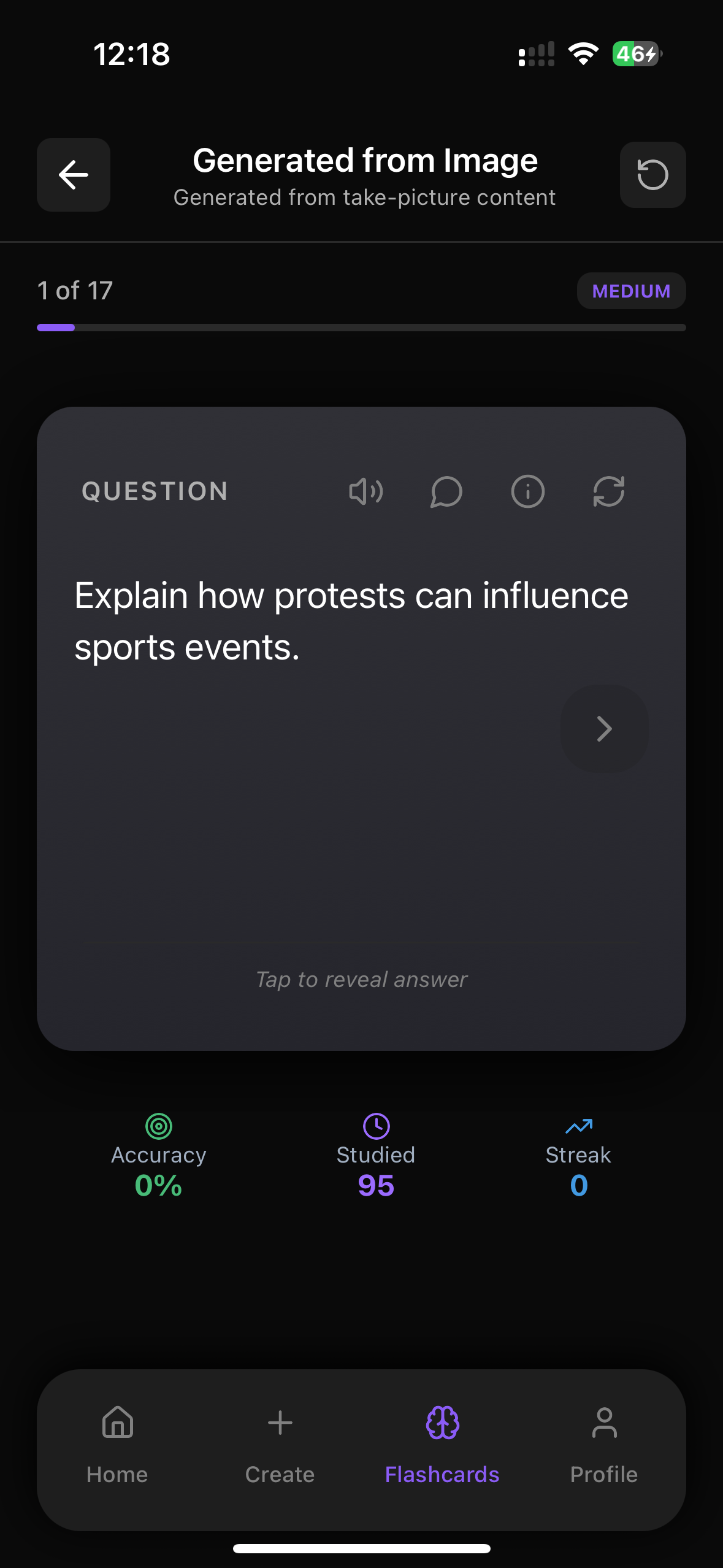
- Or just snap a photo of your notes, textbook, or practice problems and let the app turn them into flashcards for you
- Or paste text from an SAT passage / PDF and auto‑generate cards
So you’re not stuck spending hours formatting cards instead of actually studying.
2. Why Most SAT Flashcards Don’t Work (And How To Fix That)
The big mistake: passive review.
Just flipping a card, reading it, and going “yeah I know that” doesn’t do much.
Your brain only really learns when it has to struggle a bit to remember.
That’s where active recall and spaced repetition come in.
Active Recall = Forcing Your Brain To Answer
Instead of:
> See word → read definition → move on
Do this:
> See word → try to say definition from memory → then flip and check yourself
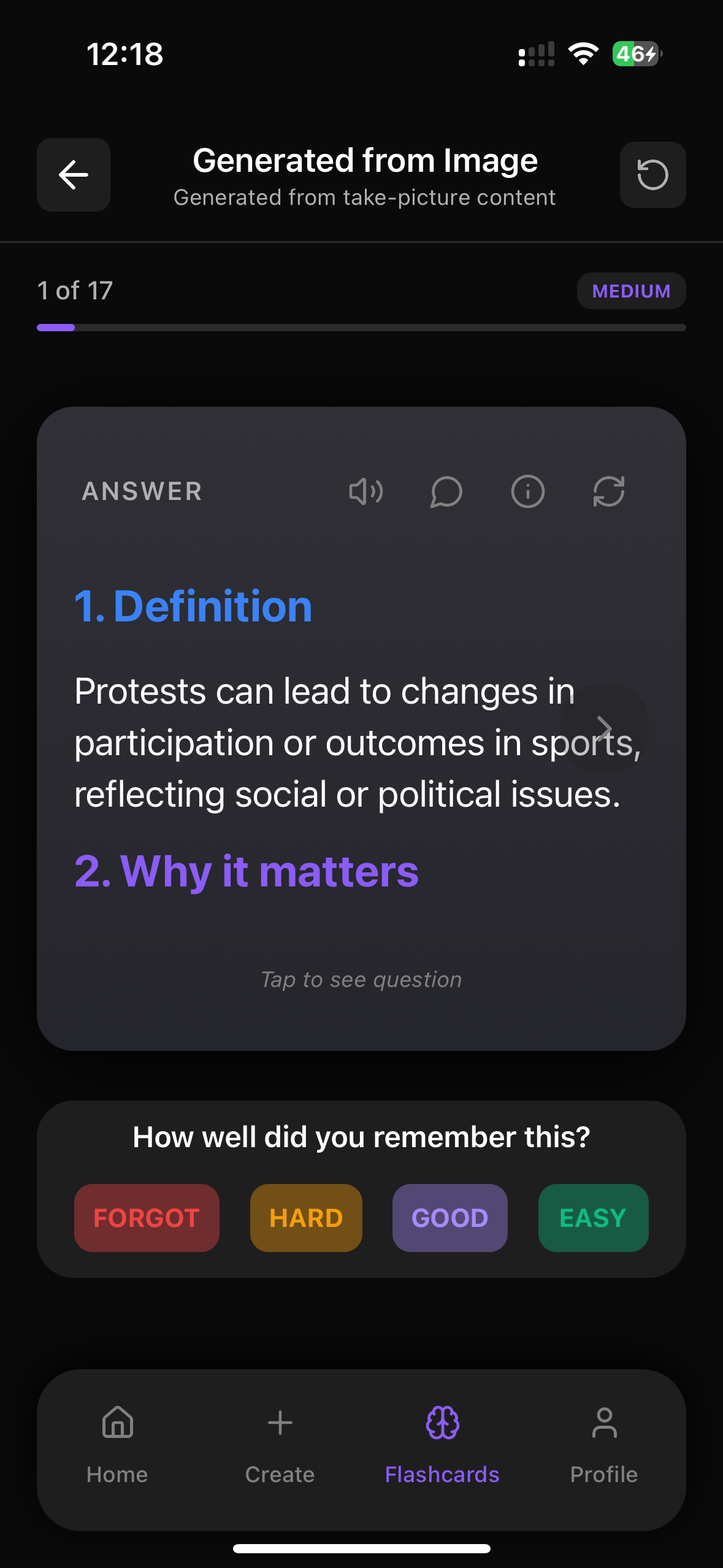
Flashrecall is literally built around this. Each card is shown, you answer in your head (or out loud), then you grade how well you knew it. No mindless scrolling.
Spaced Repetition = Reviewing At The Perfect Time
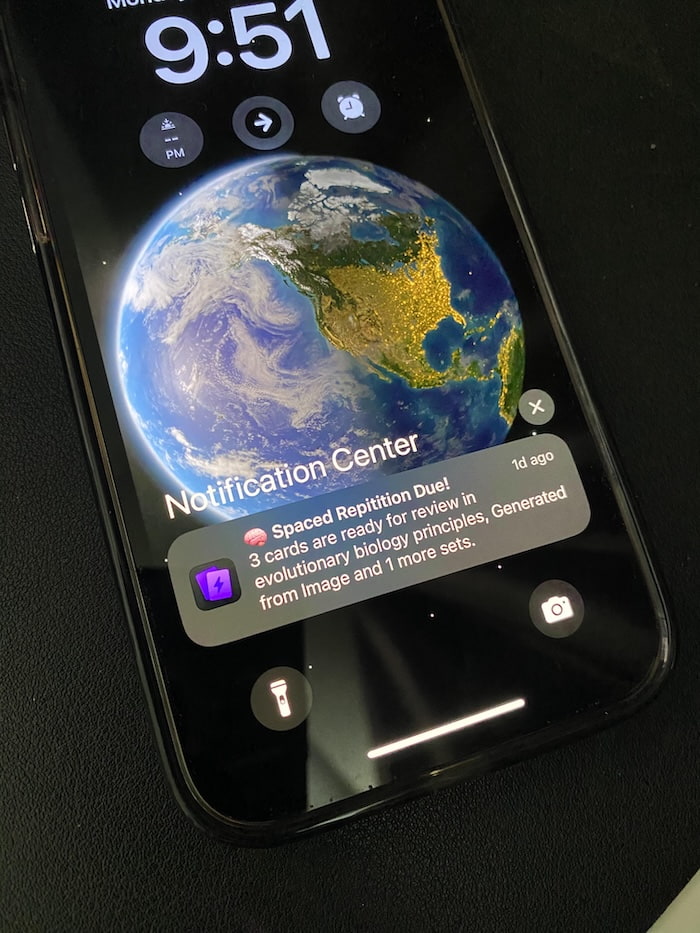
Flashrecall automatically keeps track and reminds you of the cards you don't remember well so you remember faster. Like this :
If you see a card too often, you waste time.
If you see it too late, you forget it.
Spaced repetition finds the sweet spot: right before you’re about to forget.
Flashrecall has built‑in spaced repetition with auto reminders, so:
- It schedules reviews for you
- It reminds you when it’s time to study
- Hard cards show up more often
- Easy cards are spaced out further
You don’t have to manage anything — just open the app and do the cards it gives you.
3. How To Build SAT Flashcards Fast (Without Losing Your Mind)
You don’t need to perfectly “organize” everything before you start. Just get cards in.
With Flashrecall, you’ve got a bunch of ways to do this quickly:
🔹 Option 1: Turn Practice Questions Into Cards
Doing practice tests? Every time you miss a question, turn it into a card.
With Flashrecall you can:
- Take a photo of the question → auto‑generate a card
- Highlight the key concept in the explanation → make a definition / rule card
- Add your own “why I got this wrong” note on the back
This is insanely powerful because you’re literally studying your own mistakes, not some generic list.
🔹 Option 2: Use Text, PDFs, and YouTube
Studying from:
- SAT prep books (PDFs)
- Online vocab lists
- YouTube explanations?
You can:
- Paste text or upload PDFs into Flashrecall → auto‑create flashcards
- Drop a YouTube link and pull key info into cards
- Then you just tweak or delete what you don’t need
🔹 Option 3: Manual Cards For High‑Value Stuff
Some cards are worth crafting by hand:
- Your personal “formula sheet”
- Your most frequently missed grammar rules
- Short reading strategies (“For main idea: read intro + conclusion + topic sentences”)
Flashrecall lets you make manual cards super quickly, and it all syncs on your iPhone and iPad, plus it works offline — so you can study on the bus, in bed, or during those awkward 7‑minute breaks.
4. How Often Should You Study SAT Flashcards?
You don’t need 3‑hour grind sessions every day.
Consistency > intensity.
A good baseline:
- 1–3 months before the SAT
- 20–40 minutes of flashcards per day
- Mix vocab, math, and grammar
- Last 2 weeks
- Shorter but more focused sessions (15–30 minutes)
- Only the most important / hardest cards
With Flashrecall’s study reminders, you can set:
- Daily review reminders (e.g., 8 pm every night)
- Or just rely on the app’s spaced repetition notifications
The goal is simple: never let your cards pile up into a scary mountain.
5. Make Your SAT Flashcards Actually Good (Not Just “Fine”)
A good card is:
- Short
- Clear
- Focused on one idea
✅ Good SAT flashcard examples
❌ Bad SAT flashcards
- Front: “All comma rules”
Back: A giant paragraph of text
- Front: A full SAT question with no highlighting or focus
Back: A full explanation
If you do add a full question (which is sometimes useful), add a second card with the core concept behind it. Flashrecall makes this easy — you can duplicate a card and edit the copy into a shorter, concept‑focused version.
6. Use “Chat With Your Flashcards” When You’re Stuck
One of the coolest things about Flashrecall is you can actually chat with the flashcard.
So if you’re like:
- “I still don’t get why this answer is wrong”
- “Can you explain this formula like I’m 12?”
- “Give me another example of this grammar rule”
You can ask inside the app, and it’ll break it down for you right there — using the info already on your cards.
This is huge for SAT math and grammar when explanations in prep books feel way too formal or confusing.
7. A Simple SAT Flashcard Routine You Can Steal
Here’s a realistic daily plan using Flashrecall:
On a school day (20–30 minutes total)
- Open Flashrecall
- Do the cards it schedules for you (spaced repetition)
- Focus on vocab + grammar
- Do a few SAT practice questions
- Any question you miss → snap a pic → turn into Flashrecall cards
- Add 5–10 new cards max (quality > quantity)
- Finish your scheduled reviews
That’s it. No crazy 4‑hour sessions. Just steady, smart repetition.
Why Use Flashrecall For SAT Flashcards?
You could use paper cards or a clunky app. But for the SAT, you want:
- Speed – auto‑create cards from images, text, PDFs, YouTube, or typed prompts
- Smart review – built‑in spaced repetition and active recall
- Less friction – no need to remember what to study; the app tells you
- Flexibility – works offline, on iPhone and iPad
- Depth – you can chat with your flashcards when something doesn’t click
- Free to start – so you can try it without committing
Here’s the link again if you want to set it up now and start building your SAT deck today:
👉 https://apps.apple.com/us/app/flashrecall-study-flashcards/id6746757085
If you start now and stick to short daily sessions, your future self on SAT day is going to be very grateful you didn’t wait.
Frequently Asked Questions
What's the fastest way to create flashcards?
Manually typing cards works but takes time. Many students now use AI generators that turn notes into flashcards instantly. Flashrecall does this automatically from text, images, or PDFs.
Is there a free flashcard app?
Yes. Flashrecall is free and lets you create flashcards from images, text, prompts, audio, PDFs, and YouTube videos.
How do I start spaced repetition?
You can manually schedule your reviews, but most people use apps that automate this. Flashrecall uses built-in spaced repetition so you review cards at the perfect time.
Related Articles
- Flashcards World Website Alternatives: 7 Powerful Ways To Study Smarter On Your Phone – Stop Wasting Time In Your Browser And Turn Your iPhone Into A Learning Machine
- LSAT Flashcards: Proven Study Hacks To Boost Your Score Faster Than Practice Tests Alone – Learn how to actually remember what you study and turn LSAT content into automatic points on test day.
- EPA 608 Flashcards: The Proven Way To Pass Your HVAC Exam Faster (Most Techs Don’t Study Like This) – Stop rereading the manual and start using smart flashcards that actually make the 608 stick.
Research References
The information in this article is based on peer-reviewed research and established studies in cognitive psychology and learning science.
Cepeda, N. J., Pashler, H., Vul, E., Wixted, J. T., & Rohrer, D. (2006). Distributed practice in verbal recall tasks: A review and quantitative synthesis. Psychological Bulletin, 132(3), 354-380
Meta-analysis showing spaced repetition significantly improves long-term retention compared to massed practice
Carpenter, S. K., Cepeda, N. J., Rohrer, D., Kang, S. H., & Pashler, H. (2012). Using spacing to enhance diverse forms of learning: Review of recent research and implications for instruction. Educational Psychology Review, 24(3), 369-378
Review showing spacing effects work across different types of learning materials and contexts
Kang, S. H. (2016). Spaced repetition promotes efficient and effective learning: Policy implications for instruction. Policy Insights from the Behavioral and Brain Sciences, 3(1), 12-19
Policy review advocating for spaced repetition in educational settings based on extensive research evidence
Karpicke, J. D., & Roediger, H. L. (2008). The critical importance of retrieval for learning. Science, 319(5865), 966-968
Research demonstrating that active recall (retrieval practice) is more effective than re-reading for long-term learning
Roediger, H. L., & Butler, A. C. (2011). The critical role of retrieval practice in long-term retention. Trends in Cognitive Sciences, 15(1), 20-27
Review of research showing retrieval practice (active recall) as one of the most effective learning strategies
Dunlosky, J., Rawson, K. A., Marsh, E. J., Nathan, M. J., & Willingham, D. T. (2013). Improving students' learning with effective learning techniques: Promising directions from cognitive and educational psychology. Psychological Science in the Public Interest, 14(1), 4-58
Comprehensive review ranking learning techniques, with practice testing and distributed practice rated as highly effective

FlashRecall Team
FlashRecall Development Team
The FlashRecall Team is a group of working professionals and developers who are passionate about making effective study methods more accessible to students. We believe that evidence-based learning tec...
Credentials & Qualifications
- •Software Development
- •Product Development
- •User Experience Design
Areas of Expertise
Ready to Transform Your Learning?
Start using FlashRecall today - the AI-powered flashcard app with spaced repetition and active recall.
Download on App Store