Sound Flash Cards Tips: The Powerful Guide
Sound flash cards tips enhance learning by adding audio—like pronunciations and sounds—making it easier to remember. Use Flashrecall to create them quickly!
How Flashrecall app helps you remember faster. It's free
What Are Sound Flash Cards (And Why They’re So Underrated)?
Hey there! Let’s chat about sound flash cards tips because, honestly, they're like having a cheat sheet for learning. You know how sometimes info feels like it's trying to escape your brain? Well, flashcards can break it down into manageable chunks. They're perfect for everything from prepping for tests to immersing yourself in a new language or hobby. The key is using them wisely—think active recall and spaced repetition. And Flashrecall? It's like your personal organizer, turning your notes into flashcards and giving you a nudge when it's time to review. If you want to see how flashcards can be your ultimate study buddy, pop over to our complete guide.
Instead of only reading a word or definition, you hear it too.
That might be:
- A word pronounced out loud
- A phrase in another language
- A medical term spoken clearly
- A sound effect (like a heart murmur, bird call, or instrument note)
- A short explanation you recorded yourself
And here’s where it gets fun: with an app like Flashrecall
👉 https://apps.apple.com/us/app/flashrecall-study-flashcards/id6746757085
you can create these sound flash cards in seconds from audio, text, YouTube, and more.
Most people only use text flashcards. That works… but adding sound hits your brain from another angle, which makes things stick way better.
Why Sound Makes Flashcards So Much More Powerful
Think about how you actually use knowledge in real life:
- When speaking a new language, you need to hear and say it, not just read it.
- In medicine or music, you often recognize things by sound first.
- In presentations or business, you remember stories and explanations better when you’ve heard them.
Sound flash cards help with:
1. Pronunciation (No More Guessing)
If you’re learning languages, you know this pain:
You can read the word perfectly… then completely butcher it out loud.
With audio on your flashcards, you can:
- Hear a native-like pronunciation
- Repeat it aloud
- Compare yourself to the audio
- Build muscle memory for your mouth, not just your eyes
In Flashrecall, you can:
- Add audio directly to a card
- Or even pull content from a YouTube video and turn it into cards (with sound!)
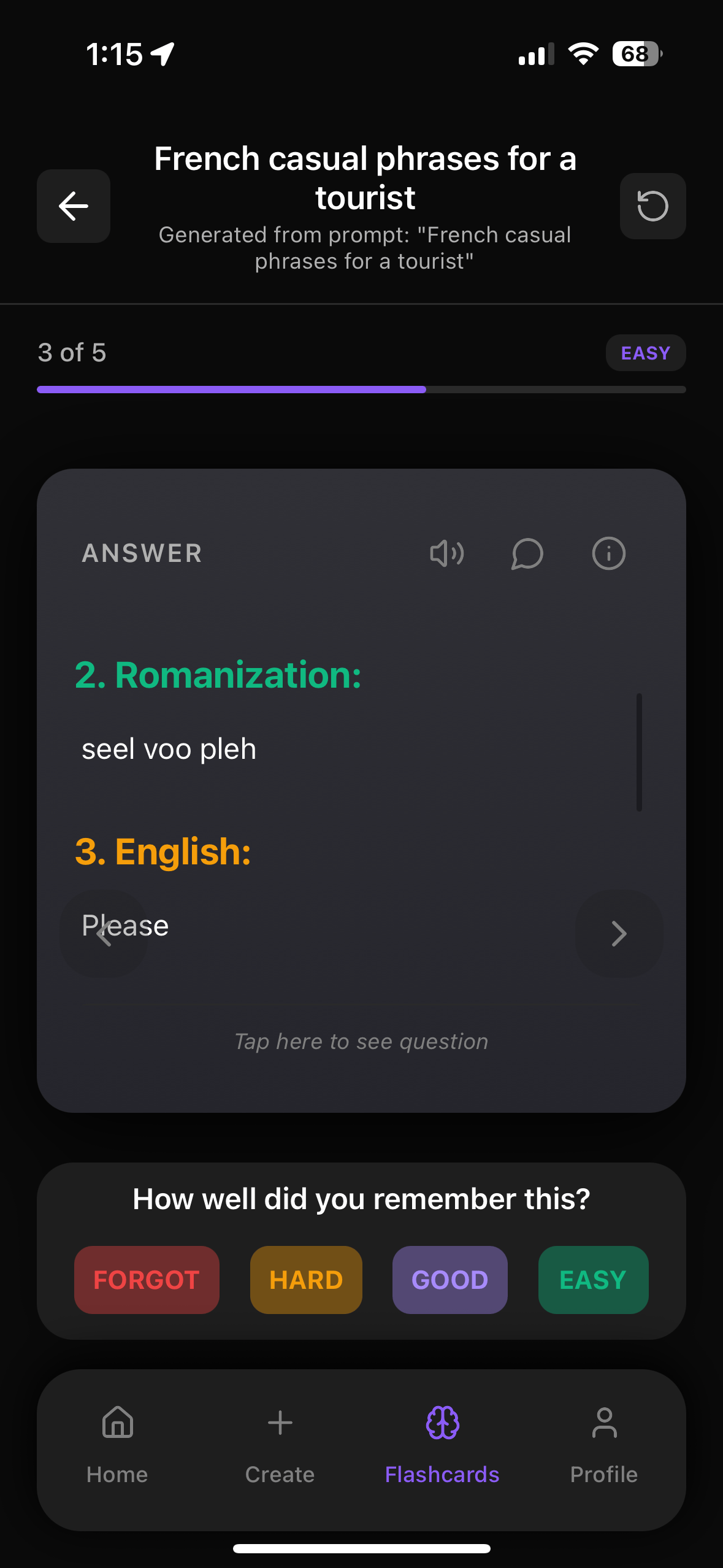
So instead of “bonjour = hello” as plain text, you get:
- Front: “bonjour” (audio plays)
- Back: “hello” + maybe a sentence with audio
Way more realistic, way more memorable.
2. Listening Skills (Not Just Reading)
So many learners are “good on paper” but freeze when they have to listen in real time.
Sound flash cards force you to practice listening:
- Front of the card: play audio only
- Your job: write/say what you heard
- Back: show the correct text + translation
You can do this easily in Flashrecall by:
- Uploading short audio clips
- Recording your own voice
- Using content pulled from podcasts or videos (via links or transcripts)
Over time, you train your ear, not just your reading ability.
3. Memory Hooks (Sound Sticks In Your Brain)
Your brain loves patterns, rhythm, tone, and “weird” sounds.
If you attach a sound to a concept, you’re giving your brain another hook to hold onto.
Examples:
- Studying biology? Attach a short audio explanation of “mitosis” in your own words.
- Learning music theory? Use sound clips of intervals, chords, or scales.
- Studying for med school? Add heart sounds, lung sounds, or murmurs.
In Flashrecall, you can:
- Record a quick 5–10 second explanation in your own voice
- Attach it to the card so every time you review, you hear your own summary
That’s active recall + audio + personal explanation all in one.
How Flashrecall Makes Sound Flash Cards Stupidly Easy
You can do sound flash cards with old-school methods… but it’s a hassle.
Flashrecall makes it fast:
👉 Download it here (free to start):
https://apps.apple.com/us/app/flashrecall-study-flashcards/id6746757085
Here’s what makes it great for audio-based cards:
1. Create Cards From Almost Anything
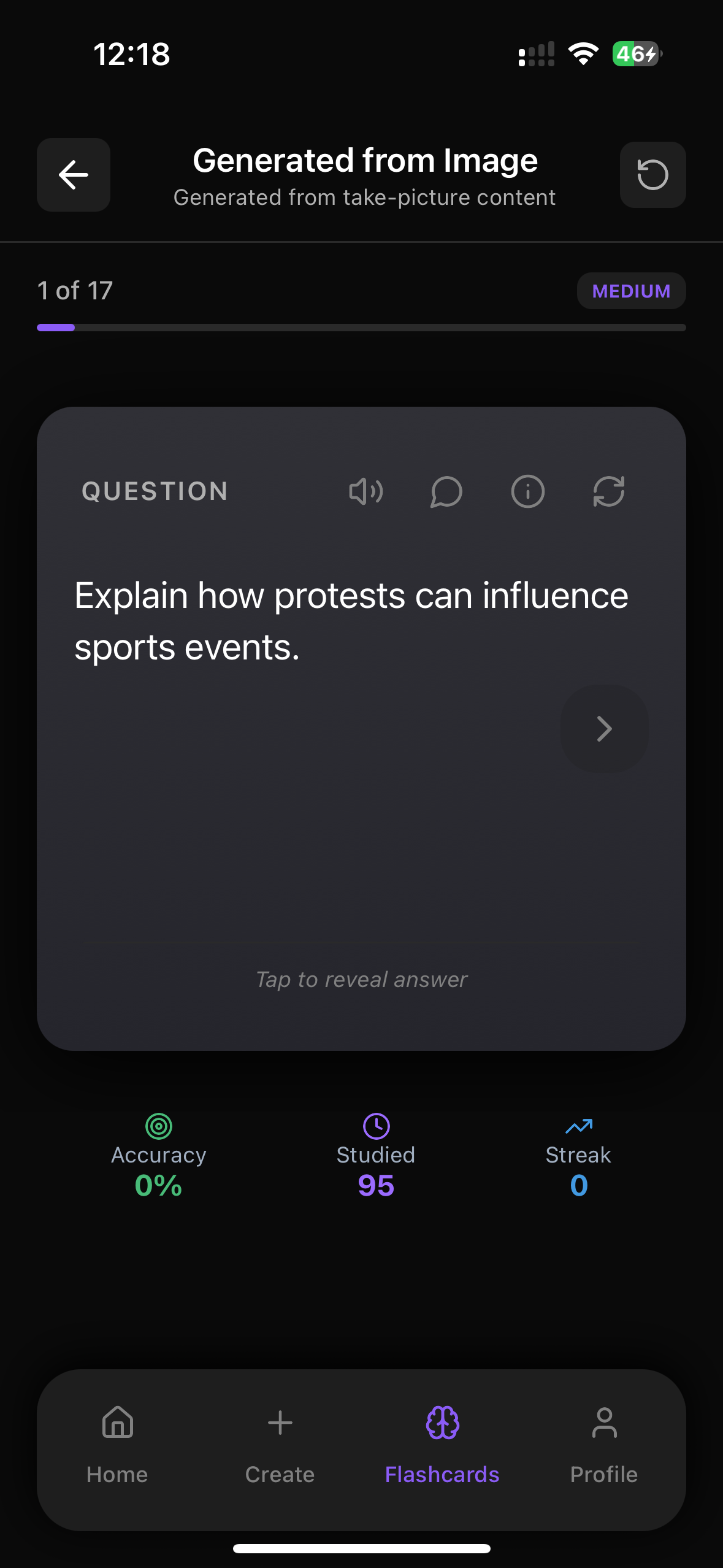
Flashrecall automatically keeps track and reminds you of the cards you don't remember well so you remember faster. Like this :
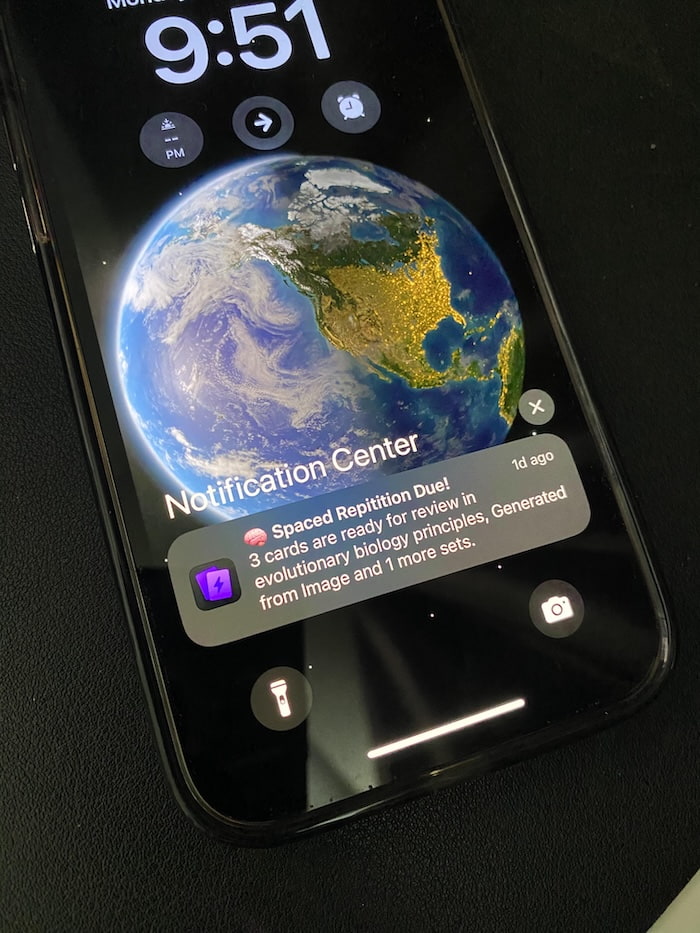
With Flashrecall, you can instantly make flashcards from:
- Audio (record directly in the app or upload)
- Text (copy-paste, notes, articles, etc.)
- Images (photos of textbooks, slides, handwritten notes)
- PDFs (syllabus, lecture slides, ebooks)
- YouTube links (pull key info from videos)
- Typed prompts (just tell it what you’re learning)
- Or just manual cards if you like full control
So if you have a vocab audio list, a lecture recording, or a pronunciation video, you can turn that into sound flash cards in minutes instead of hours.
2. Built-In Active Recall (Not Just Passive Listening)
Sound flash cards are only powerful if you’re actually testing yourself, not just listening on autopilot.
Flashrecall is built around active recall:
- You see or hear the prompt
- You try to answer from memory
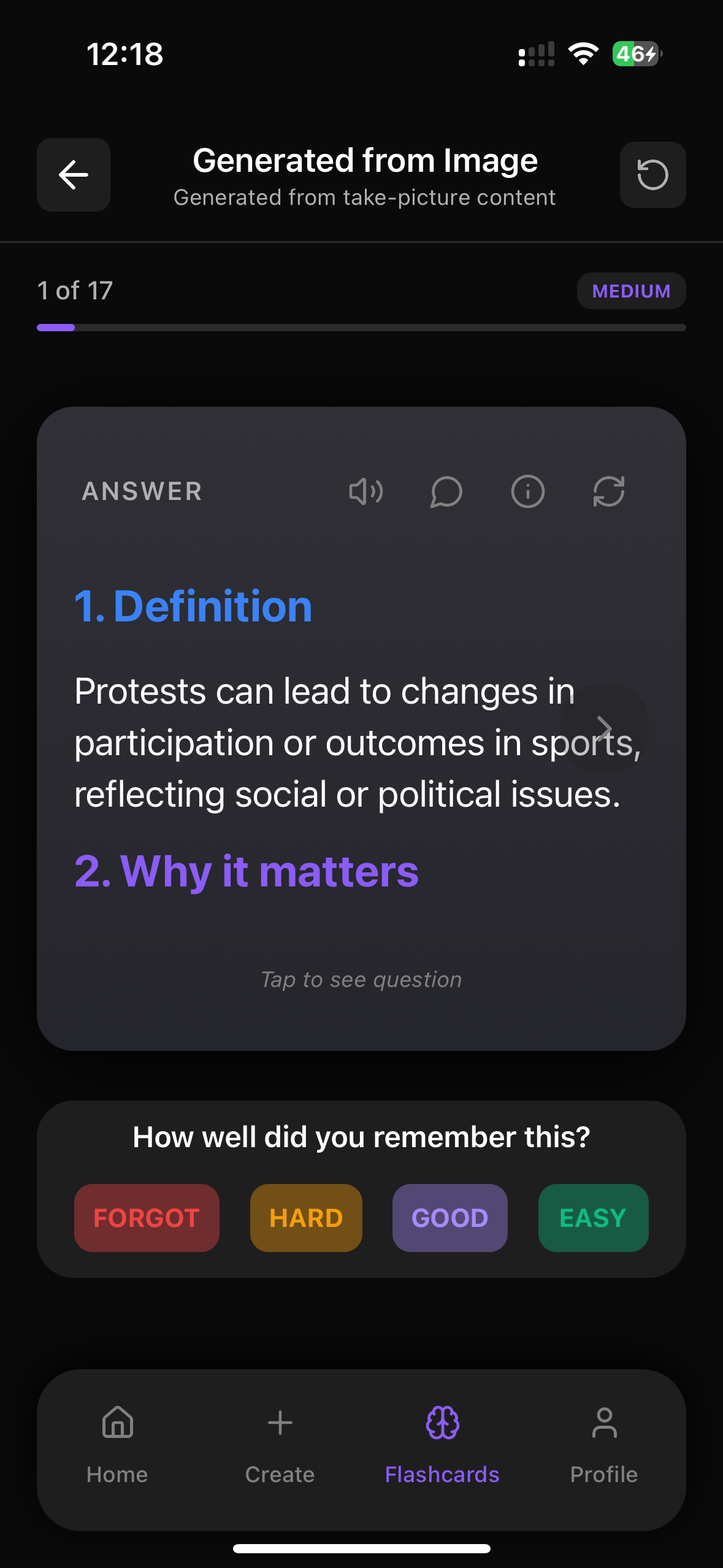
- Then you reveal the answer and rate how hard it was
You can structure sound cards like:
- Audio → Text
- Front: play audio of a sentence
- Back: show the sentence + translation
- Text → Audio
- Front: show the word/phrase
- Back: play the audio so you can repeat
- Question → Audio Explanation
- Front: “Explain the difference between X and Y”
- Back: your own recorded explanation
That “struggle then reveal” is what wires the memory.
3. Automatic Spaced Repetition (With Reminders)
Sound flash cards are great… but only if you actually review them.
Flashrecall has built-in spaced repetition with auto reminders:
- Cards you know well show up less often
- Cards you keep missing show up more
- You don’t have to manually track anything
Plus, you get study reminders, so you don’t forget to review.
Open the app, and it already knows what you should study today. No planning, no spreadsheets.
4. Works Offline (Perfect For Commuting With Audio)
Got a commute, walk, or random waiting time? Perfect for sound flash cards.
Flashrecall works offline on iPhone and iPad, so you can:
- Review audio cards on the train
- Practice pronunciation during a walk
- Listen to your recorded summaries anywhere
No Wi-Fi? No problem.
5. Chat With Your Flashcards When You’re Stuck
This is one of the coolest parts.
If you’re unsure about something on a card, you can literally chat with the flashcard in Flashrecall:
- Don’t understand a definition? Ask it to explain more simply.
- Need more examples? Ask for them.
- Want a quick analogy? Just type the question.
So if you have a sound flash card with a concept you don’t fully get, you’re not stuck—you can turn it into a mini tutor session.
Real Examples: How To Use Sound Flash Cards For Different Subjects
1. Languages (The Most Obvious Use)
Use sound flash cards to:
- Practice pronunciation
- Train listening comprehension
- Learn natural phrases, not just single words
Example card setups in Flashrecall:
- Card Type 1: Listening Drill
- Front: audio of a native sentence
- Back: written sentence + translation
- Card Type 2: Speaking Practice
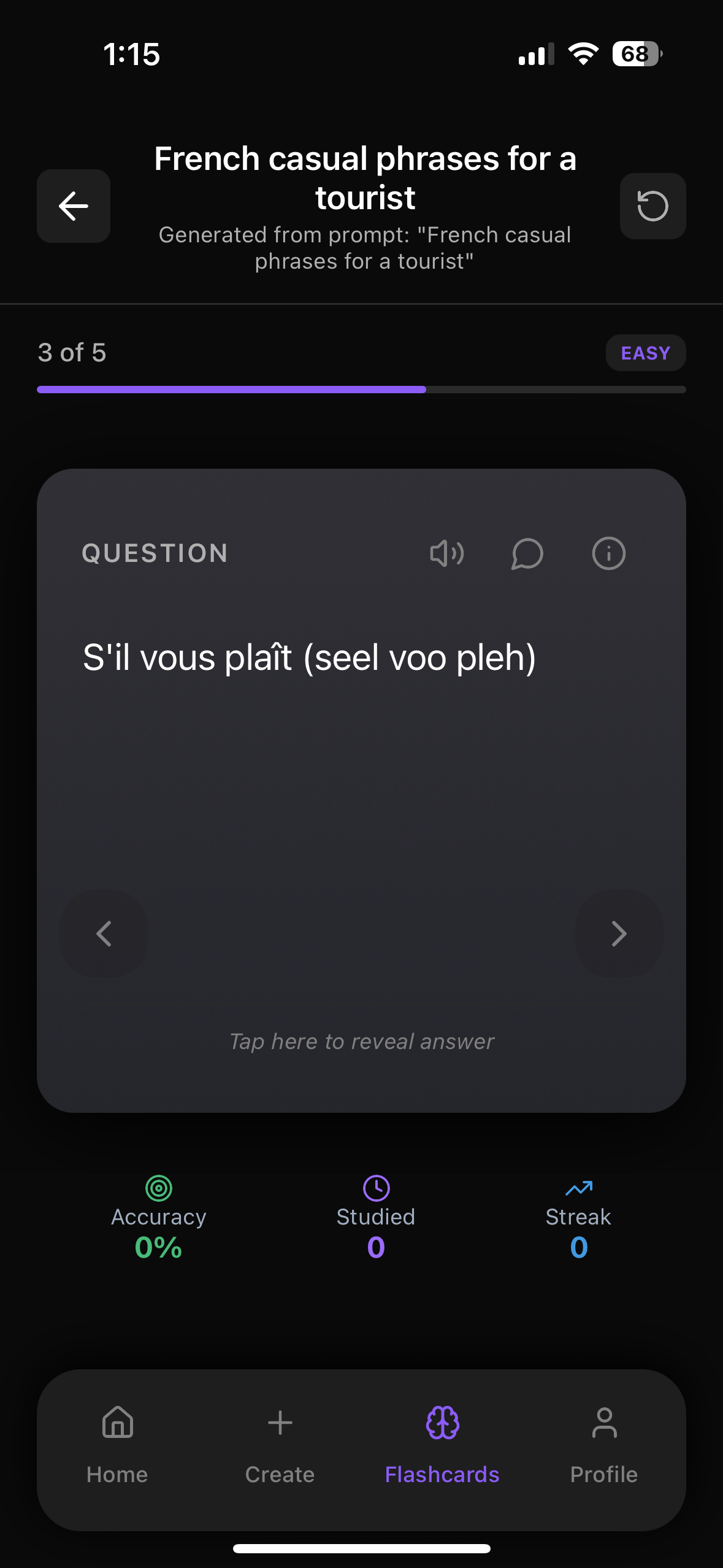
- Front: written phrase
- Back: audio of correct pronunciation
You can make these quickly from:
- YouTube videos (interviews, dialogues, lessons)
- Audio lessons you already have
- Your own recordings (you or a native speaker)
2. Medicine, Nursing, Biology
Sound is huge for medical learners:
- Heart sounds (murmurs, gallops, etc.)
- Lung sounds (crackles, wheezes)
- Bowel sounds
- Short audio explanations of complex topics
Example:
- Front: “Identify this heart sound” + audio
- Back: “Mitral regurgitation – pansystolic murmur best heard at the apex”
You can also record your own 15-second “explain like I’m five” summary and attach it to the card. Reviewing those with spaced repetition in Flashrecall is insanely effective.
3. Music, Ear Training, and Instruments
If you’re learning music, sound flash cards are a no-brainer:
- Intervals (minor third, perfect fifth, etc.)
- Chords (major, minor, dominant 7th)
- Scales and modes
- Rhythm patterns
Examples:
- Front: play an interval
- Back: “Perfect fourth”
- Front: chord audio
- Back: “Minor 7 chord”
You can build a whole ear training deck in Flashrecall and run through it daily with automatic spaced repetition.
4. Presentations, Business, and Public Speaking
Not just for “school stuff.”
You can use sound flash cards to:
- Practice your pitch or speech
- Record key talking points
- Memorize sales scripts or client questions
Example:
- Front: “Opening line for Product X pitch”
- Back: audio of you saying your ideal opening
You can rehearse by listening and repeating, then gradually wean off the audio until you’ve memorized it.
Simple Workflow: How To Start Using Sound Flash Cards Today
Here’s a super simple way to get going:
1. Download Flashrecall
👉 https://apps.apple.com/us/app/flashrecall-study-flashcards/id6746757085
2. Pick One Topic
- Language vocab
- A tricky lecture
- Anatomy, music, anything
3. Create 10–20 Sound Cards
- Record short audio (pronunciations, explanations, sounds)
- Or pull from a YouTube video / audio file
- Keep each clip short (5–15 seconds is ideal)
4. Review Daily With Spaced Repetition
- Let Flashrecall schedule your reviews
- Rate how hard each card was
- Focus on the ones you keep missing
5. Talk To Your Cards When Confused
- Use the “chat with flashcard” feature to clarify concepts
- Ask for simpler explanations or more examples
Do this for a week and you’ll feel the difference—especially for anything involving listening or pronunciation.
Why Flashrecall Beats Basic Flashcard Apps For Sound
A lot of flashcard apps let you “attach audio,” but Flashrecall is built for actually learning, not just storing data:
- Instant card creation from text, images, PDFs, YouTube, and audio
- Built-in active recall + spaced repetition (no manual scheduling)
- Study reminders so you don’t fall off the wagon
- Works offline on iPhone and iPad
- Chat with your flashcards when you’re stuck
- Fast, modern, easy to use interface
- Free to start, so you can test it without commitment
- Great for languages, exams, school subjects, university, medicine, business—anything you want to remember
If you’re only using silent, text-only cards, you’re leaving a massive learning boost on the table.
Final Thought: Don’t Just Read Your Flashcards—Hear Them
Sound flash cards turn your study sessions from flat and boring into something closer to real life:
- You hear how things are actually used
- You train your ear, not just your eyes
- You remember faster and forget less
If you want an easy way to try this today, grab Flashrecall here:
👉 https://apps.apple.com/us/app/flashrecall-study-flashcards/id6746757085
Make a small deck with audio, review it for a few days, and see how much more natural everything feels.
Frequently Asked Questions
What's the fastest way to create flashcards?
Manually typing cards works but takes time. Many students now use AI generators that turn notes into flashcards instantly. Flashrecall does this automatically from text, images, or PDFs.
Is there a free flashcard app?
Yes. Flashrecall is free and lets you create flashcards from images, text, prompts, audio, PDFs, and YouTube videos.
What's the best way to learn vocabulary?
Research shows that combining flashcards with spaced repetition and active recall is highly effective. Flashrecall automates this process, generating cards from your study materials and scheduling reviews at optimal intervals.
Related Articles
- Audible Flash Cards: The Complete Guide To Learning Faster With Audio You Can Review Anywhere – Most Students Ignore This Powerful Trick
- Quizlet Audio Flashcards: The Best Alternative To Study Faster With Powerful Voice-Driven Learning – Discover the smarter way to learn with audio, spaced repetition, and AI-powered flashcards that actually stick.
- Slide And Learn Flash Cards: The Powerful Upgrade Students Need To Learn Faster (Most People Don’t Know This Trick)
Research References
The information in this article is based on peer-reviewed research and established studies in cognitive psychology and learning science.
Cepeda, N. J., Pashler, H., Vul, E., Wixted, J. T., & Rohrer, D. (2006). Distributed practice in verbal recall tasks: A review and quantitative synthesis. Psychological Bulletin, 132(3), 354-380
Meta-analysis showing spaced repetition significantly improves long-term retention compared to massed practice
Carpenter, S. K., Cepeda, N. J., Rohrer, D., Kang, S. H., & Pashler, H. (2012). Using spacing to enhance diverse forms of learning: Review of recent research and implications for instruction. Educational Psychology Review, 24(3), 369-378
Review showing spacing effects work across different types of learning materials and contexts
Kang, S. H. (2016). Spaced repetition promotes efficient and effective learning: Policy implications for instruction. Policy Insights from the Behavioral and Brain Sciences, 3(1), 12-19
Policy review advocating for spaced repetition in educational settings based on extensive research evidence
Karpicke, J. D., & Roediger, H. L. (2008). The critical importance of retrieval for learning. Science, 319(5865), 966-968
Research demonstrating that active recall (retrieval practice) is more effective than re-reading for long-term learning
Roediger, H. L., & Butler, A. C. (2011). The critical role of retrieval practice in long-term retention. Trends in Cognitive Sciences, 15(1), 20-27
Review of research showing retrieval practice (active recall) as one of the most effective learning strategies
Dunlosky, J., Rawson, K. A., Marsh, E. J., Nathan, M. J., & Willingham, D. T. (2013). Improving students' learning with effective learning techniques: Promising directions from cognitive and educational psychology. Psychological Science in the Public Interest, 14(1), 4-58
Comprehensive review ranking learning techniques, with practice testing and distributed practice rated as highly effective

FlashRecall Team
FlashRecall Development Team
The FlashRecall Team is a group of working professionals and developers who are passionate about making effective study methods more accessible to students. We believe that evidence-based learning tec...
Credentials & Qualifications
- •Software Development
- •Product Development
- •User Experience Design
Areas of Expertise
Ready to Transform Your Learning?
Start using FlashRecall today - the AI-powered flashcard app with spaced repetition and active recall.
Download on App Store