Teas Flashcards Study Method: The Ultimate Guide
The teas flashcards study method combines active recall and spaced repetition for long-term retention. Use Flashrecall to automate your study sessions.
How Flashrecall app helps you remember faster. It's free
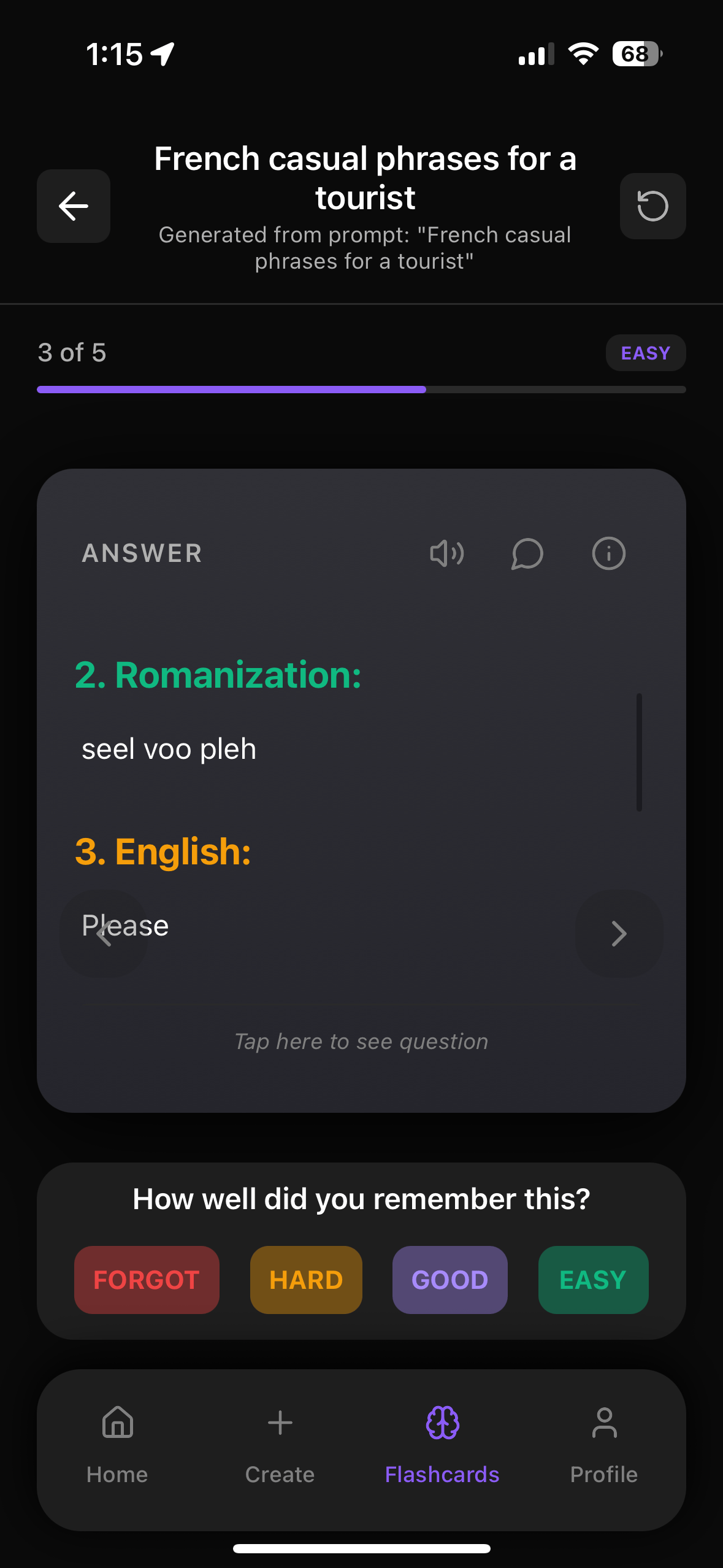
Stop Winging The TEAS — Flashcards Are Your Secret Weapon
You know how there's always that one study method that just clicks? Well, the teas flashcards study method is exactly that for a lot of folks diving into nursing exams. It basically mixes active recall with some super smart timing strategies to make sure all that info isn't just floating around short-term but sticks with you for the long haul. Instead of just cramming or flipping through notes like a zombie, you're actively pulling that info out of your brain at just the right moments. And get this, Flashrecall totally has your back on this one by automating the whole shebang—scheduling and reminders included. So, if you're ready to work smarter and not harder on your study game, seriously check out our complete guide for the inside scoop.
And instead of wasting hours making cards by hand, you can use Flashrecall, a super fast flashcard app that basically does the heavy lifting for you:
👉 https://apps.apple.com/us/app/flashrecall-study-flashcards/id6746757085
You can:
- Turn PDFs, notes, images, and even YouTube videos into flashcards automatically
- Use built‑in spaced repetition so you review at the perfect time
- Study on iPhone or iPad, even offline
- Chat with your flashcards when you’re confused and need more explanation
Let’s walk through how to actually use flashcards well for the TEAS, and how Flashrecall makes the whole process way easier.
What You Actually Need To Know For The TEAS (So You Can Make Smart Flashcards)
The TEAS isn’t testing if you’re “smart.” It’s testing if you know very specific stuff in four areas:
- Reading – main ideas, inferences, charts, passages
- Math – ratios, fractions, percentages, word problems, basic algebra
- Science – anatomy & physiology, chemistry basics, biology, scientific reasoning
- English & Language Usage – grammar, punctuation, sentence structure, spelling, word meaning
Flashcards are perfect for:
- Definitions (e.g., “homeostasis,” “cardiac output”)
- Processes (e.g., blood flow through the heart, digestion path)
- Formulas (e.g., % change, dosage calculations)
- Rules (grammar rules, math rules, conversion rules)
- Vocabulary (medical terms, academic words in reading)
What they’re not perfect for is just copying your whole textbook onto tiny cards. So let’s avoid that.
How To Turn TEAS Content Into Powerful Flashcards (Without Burning Out)
1. Use Questions, Not Just Facts
Instead of:
> Front: Cardiac output
> Back: The volume of blood pumped by the heart per minute.
Do:
> Front: What is cardiac output?
> Back: The volume of blood pumped by the heart per minute (HR × stroke volume).
That tiny change forces active recall, which is way better for memory.
Flashrecall is literally built around this idea — it leans into active recall + spaced repetition automatically, so you’re not just rereading things passively.
2. Make Your Cards Short And Specific
One card = one idea.
Bad card:
> Front: What are the functions of the skeletal system?
> Back: Support, movement, protection, blood cell production, calcium storage, endocrine regulation.
Better:
- Card 1:
- Front: What are the main functions of the skeletal system?
- Back: Support, movement, protection.
- Card 2:
- Front: What are the regulatory roles of the skeletal system?
- Back: Blood cell production, calcium storage, endocrine regulation.
Shorter cards = easier recall = less frustration.
3. Turn Your Existing Study Materials Into Flashcards (Fast)
Instead of manually typing every single card, let tech do the work.
With Flashrecall:
👉 https://apps.apple.com/us/app/flashrecall-study-flashcards/id6746757085
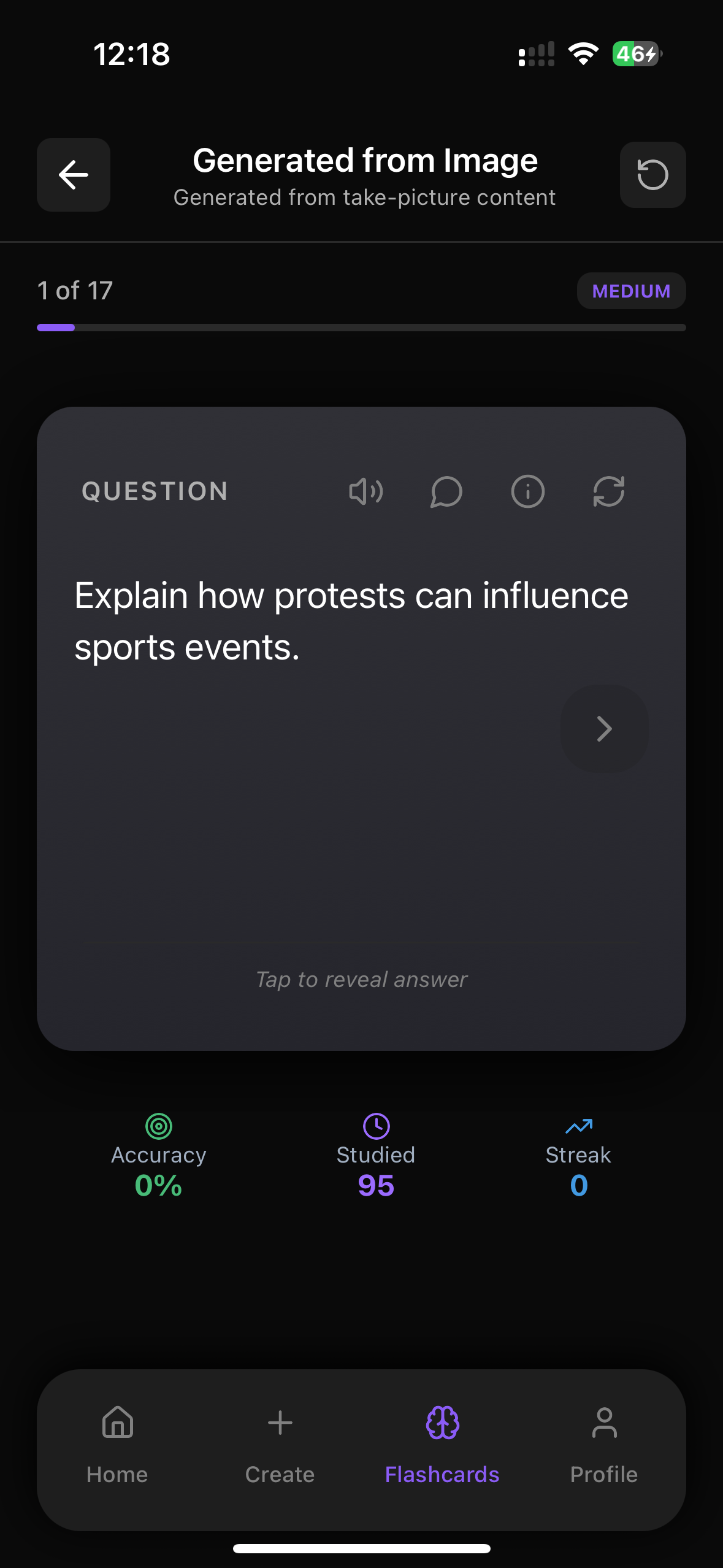
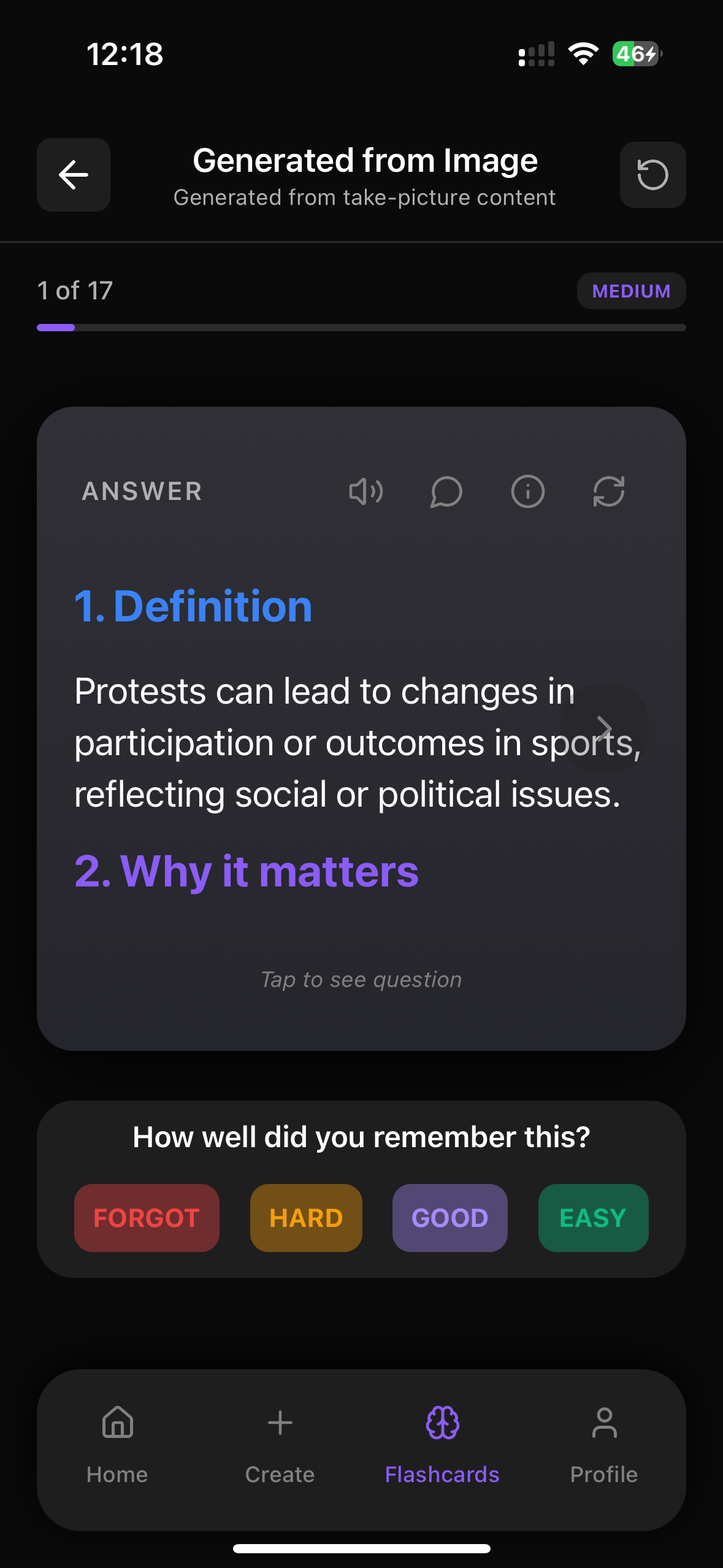
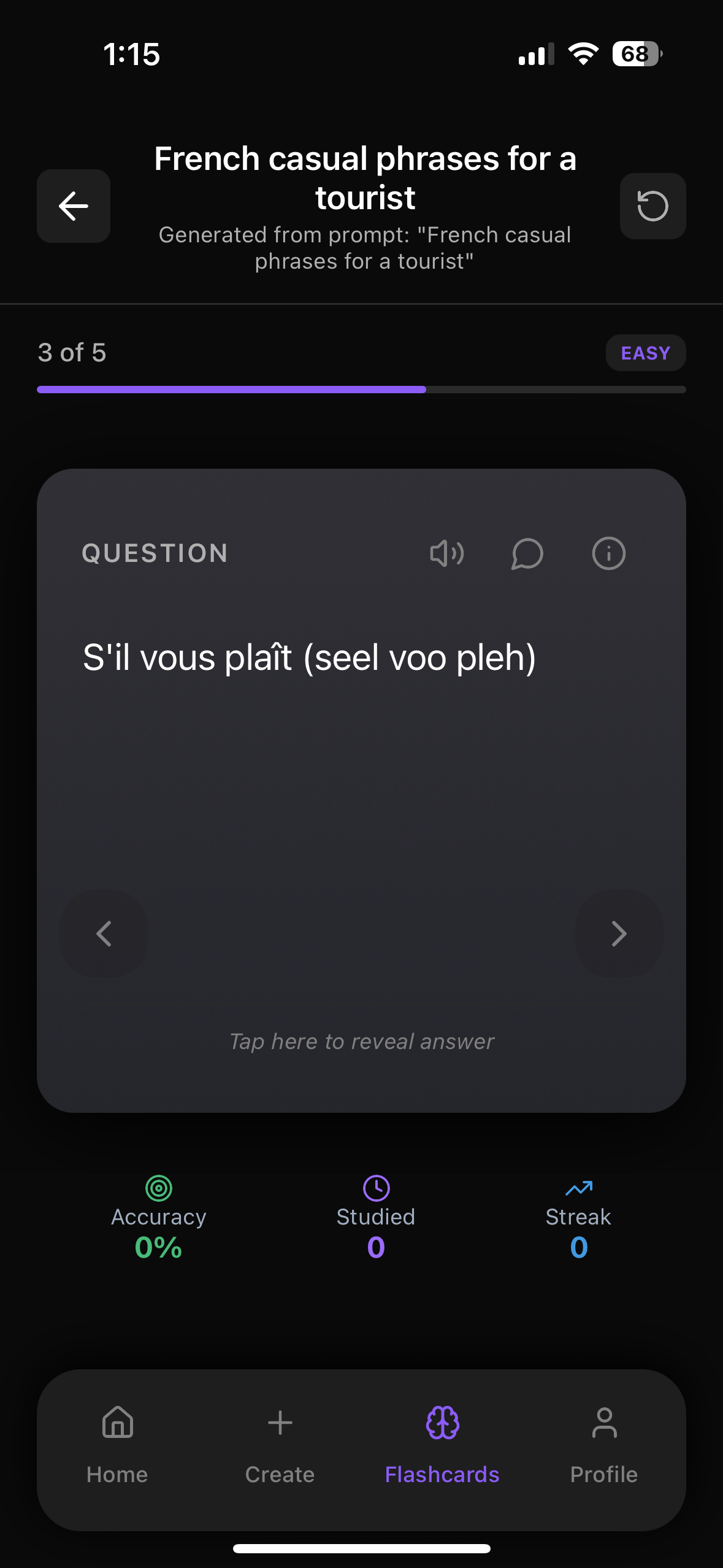
Flashrecall automatically keeps track and reminds you of the cards you don't remember well so you remember faster. Like this :
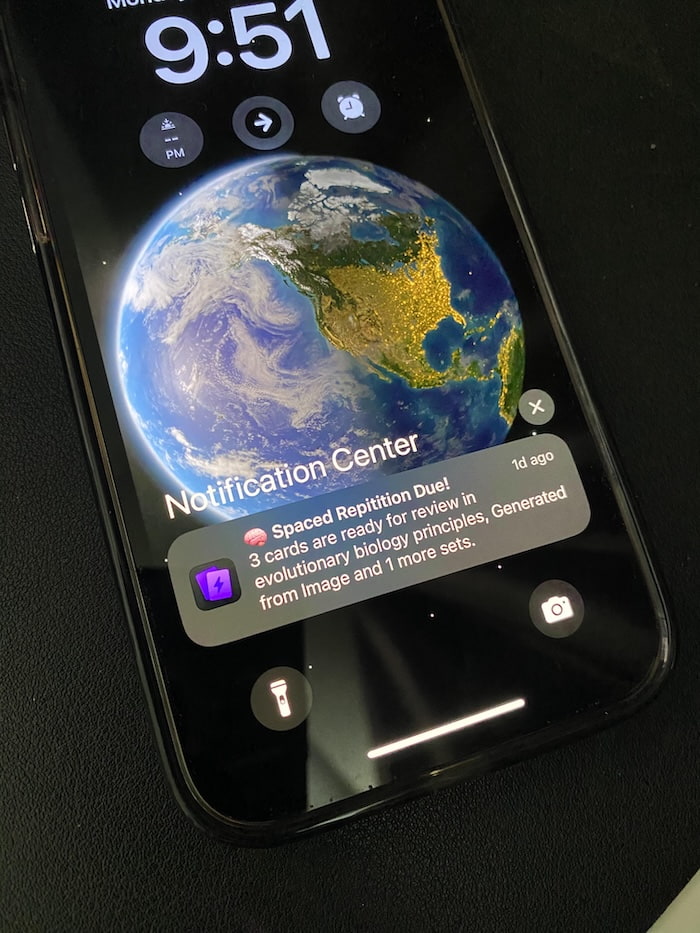
You can instantly create flashcards from:
- PDFs – TEAS study guides, class notes, review packets
- Images – textbook pages, diagrams, handwritten notes (just snap a pic)
- YouTube links – TEAS prep videos; Flashrecall can pull key info out
- Text or typed prompts – paste in a list of topics and let it help generate cards
- Audio – record yourself or lectures and turn them into cards
So instead of spending 2 hours making cards and 20 minutes studying… you flip that.
4. Use Spaced Repetition Instead Of Random Cramming
If you’ve ever reviewed something and thought, “I knew this last week, why is it gone?” — that’s what happens without spaced repetition.
Spaced repetition = reviewing info right before you’re about to forget it. That timing is the magic.
- It tracks what you get right vs wrong
- It automatically schedules the next review for each card
- It sends study reminders so you don’t forget to study at all
You don’t have to decide, “Should I review science or math today?” Flashrecall just shows you what’s due, like a personal TEAS coach.
5. Use TEAS-Specific Flashcard Strategies By Section
Focus on:
- Types of questions: main idea, inference, author’s purpose, tone
- Signal words: however, therefore, in contrast, consequently
- Common trap answers
Example flashcards:
- Front: What does “however” usually signal in a passage?
Back: A contrast or shift from the previous idea.
- Front: What is an “inference” question asking you to do?
Back: Use clues from the text + your reasoning to figure out something not directly stated.
You can also paste example passages into Flashrecall and create cards about the question types they use.
Focus on:
- Fractions, decimals, percentages
- Ratios and proportions
- Word problem setups
- Measurement conversions
- Basic algebra (solving for x)
Example flashcards:
- Front: How do you convert a fraction to a percentage?
Back: Divide numerator by denominator, then multiply by 100.
- Front: What’s the proportion formula for dosage calculations?
Back: (Desired dose / Available dose) = (x / Quantity).
In Flashrecall, you can:
- Take a photo of practice problems
- Turn them into flashcards
- Put the problem on the front and the full worked solution on the back
This is where flashcards shine.
Focus on:
- Anatomy & physiology (systems, organs, functions)
- Basic chem & bio (atoms, molecules, DNA, cellular respiration)
- Body processes (circulation, respiration, digestion)
Example flashcards:
- Front: Trace the blood flow through the heart starting at the vena cava.
Back: Vena cava → right atrium → right ventricle → pulmonary arteries → lungs → pulmonary veins → left atrium → left ventricle → aorta.
- Front: What is the function of the nephron?
Back: It filters blood and forms urine in the kidneys.
You can even upload diagrams into Flashrecall and make labeling cards from them.
Focus on:
- Common grammar errors
- Punctuation rules
- Homophones (their/there/they’re, affect/effect)
- Sentence structure (fragments, run-ons)
Example flashcards:
- Front: When do you use “affect” vs “effect”?
Back: “Affect” = verb (to influence); “effect” = noun (result).
- Front: What is a sentence fragment?
Back: An incomplete sentence missing a subject, verb, or complete thought.
Why Flashrecall Works So Well For TEAS Prep
There are tons of flashcard apps out there, but here’s why Flashrecall is especially good for TEAS:
- You don’t waste time
- Make cards from PDFs, images, YouTube, text, audio — super fast
- You don’t forget to study
- Built‑in study reminders and spaced repetition
- You learn actively
- It’s designed around active recall, not passive rereading
- You can ask questions
- You can actually chat with your flashcards if you’re unsure about a concept and want it explained differently
- It works anywhere
- Works offline, on iPhone and iPad, so you can study at work, on breaks, in the car (not driving, obviously)
- It’s flexible
- Great for TEAS now, and later for nursing school, NCLEX, meds, procedures, pathophysiology, anything
- Free to start
- You can try it without committing to anything
Grab it here:
👉 https://apps.apple.com/us/app/flashrecall-study-flashcards/id6746757085
A Simple 4-Week TEAS Flashcard Plan
You can tweak this, but here’s a solid starting point using Flashrecall.
Week 1 – Build Core Decks
- Make or import flashcards for:
- Anatomy & physiology basics
- Fractions, decimals, and percentages
- Top grammar rules
- Study 20–30 minutes per day with Flashrecall’s review queue.
Week 2 – Add Practice-Based Cards
- Take practice tests
- Any question you miss → turn into a flashcard
- Snap a pic, import into Flashrecall, add explanation on the back
- Focus on your weakest section each day.
Week 3 – Refine & Repeat
- Delete or suspend cards you’ve truly mastered
- Add more process cards (e.g., blood flow, gas exchange, nephron function)
- Use chat with flashcards when you’re stuck on a concept.
Week 4 – Intensive Review
- Let spaced repetition guide you — just clear your “due” cards daily
- Mix all sections together so your brain gets used to switching topics
- Do quick 10–15 minute sessions multiple times per day
Tiny Habits That Make A Big Difference
- Study in small chunks – 10–20 minutes, multiple times a day beats a 4‑hour cram.
- Always review “wrong” cards again the same day – Flashrecall makes this easy.
- Use idle time – waiting rooms, lunch breaks, bus rides = perfect for a quick review.
- Talk out loud – when answering flashcards, explain the answer like you’re teaching it.
Final Thoughts: TEAS Doesn’t Have To Be Scary
If the TEAS feels huge right now, that’s because you’re looking at all of it at once.
Flashcards break it into tiny, answerable questions you can conquer one by one — and Flashrecall makes creating and reviewing those cards way faster and smarter.
You handle the effort.
Let Flashrecall handle the what and when to review.
Start building your TEAS flashcards today:
👉 https://apps.apple.com/us/app/flashrecall-study-flashcards/id6746757085
Future‑you in nursing school will be very glad you did.
Frequently Asked Questions
What's the fastest way to create flashcards?
Manually typing cards works but takes time. Many students now use AI generators that turn notes into flashcards instantly. Flashrecall does this automatically from text, images, or PDFs.
Is there a free flashcard app?
Yes. Flashrecall is free and lets you create flashcards from images, text, prompts, audio, PDFs, and YouTube videos.
How do I start spaced repetition?
You can manually schedule your reviews, but most people use apps that automate this. Flashrecall uses built-in spaced repetition so you review cards at the perfect time.
What is active recall and how does it work?
Active recall is the process of actively retrieving information from memory rather than passively reviewing it. Flashrecall forces proper active recall by making you think before revealing answers, then uses spaced repetition to optimize your review schedule.
Related Articles
- ASVAB Flashcards: The Ultimate Way To Boost Your Score Fast (Most People Study Wrong) – Learn how to use ASVAB flashcards the smart way so you actually remember what you study and walk into MEPS confident.
- LSAT Flashcards: Proven Study Hacks To Boost Your Score Faster Than Practice Tests Alone – Learn how to actually remember what you study and turn LSAT content into automatic points on test day.
- EPA 608 Flashcards: The Proven Way To Pass Your HVAC Exam Faster (Most Techs Don’t Study Like This) – Stop rereading the manual and start using smart flashcards that actually make the 608 stick.
Research References
The information in this article is based on peer-reviewed research and established studies in cognitive psychology and learning science.
Cepeda, N. J., Pashler, H., Vul, E., Wixted, J. T., & Rohrer, D. (2006). Distributed practice in verbal recall tasks: A review and quantitative synthesis. Psychological Bulletin, 132(3), 354-380
Meta-analysis showing spaced repetition significantly improves long-term retention compared to massed practice
Carpenter, S. K., Cepeda, N. J., Rohrer, D., Kang, S. H., & Pashler, H. (2012). Using spacing to enhance diverse forms of learning: Review of recent research and implications for instruction. Educational Psychology Review, 24(3), 369-378
Review showing spacing effects work across different types of learning materials and contexts
Kang, S. H. (2016). Spaced repetition promotes efficient and effective learning: Policy implications for instruction. Policy Insights from the Behavioral and Brain Sciences, 3(1), 12-19
Policy review advocating for spaced repetition in educational settings based on extensive research evidence
Karpicke, J. D., & Roediger, H. L. (2008). The critical importance of retrieval for learning. Science, 319(5865), 966-968
Research demonstrating that active recall (retrieval practice) is more effective than re-reading for long-term learning
Roediger, H. L., & Butler, A. C. (2011). The critical role of retrieval practice in long-term retention. Trends in Cognitive Sciences, 15(1), 20-27
Review of research showing retrieval practice (active recall) as one of the most effective learning strategies
Dunlosky, J., Rawson, K. A., Marsh, E. J., Nathan, M. J., & Willingham, D. T. (2013). Improving students' learning with effective learning techniques: Promising directions from cognitive and educational psychology. Psychological Science in the Public Interest, 14(1), 4-58
Comprehensive review ranking learning techniques, with practice testing and distributed practice rated as highly effective

FlashRecall Team
FlashRecall Development Team
The FlashRecall Team is a group of working professionals and developers who are passionate about making effective study methods more accessible to students. We believe that evidence-based learning tec...
Credentials & Qualifications
- •Software Development
- •Product Development
- •User Experience Design
Areas of Expertise
Ready to Transform Your Learning?
Start using FlashRecall today - the AI-powered flashcard app with spaced repetition and active recall.
Download on App Store